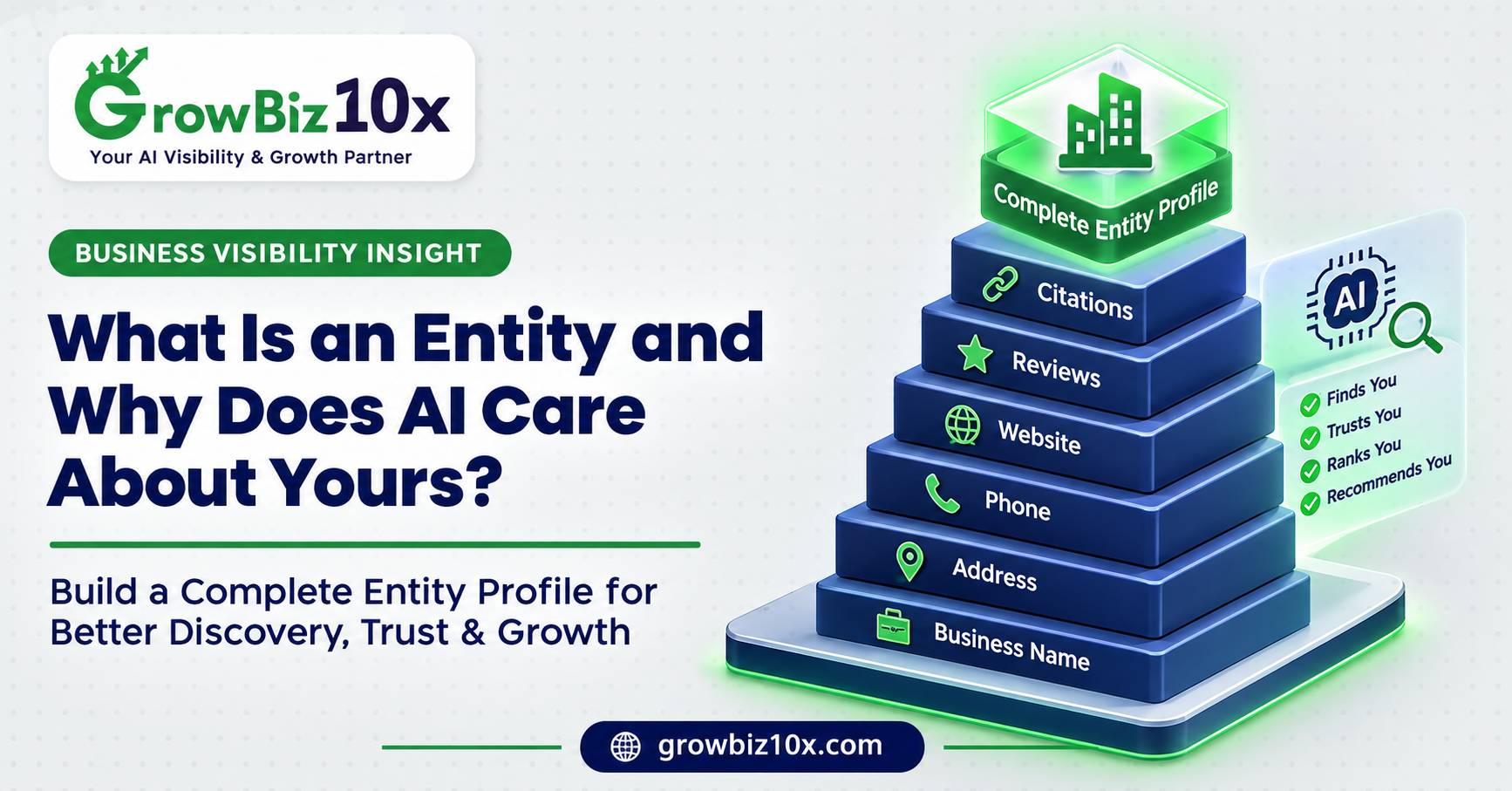
An entity is a distinct, identifiable thing that machines can recognize and reason about: a person, place, organization, product, or concept. Your business is an entity, and AI engines care because they organize knowledge around entities and their relationships rather than strings of keywords. When your business entity is clear, consistent, and well connected, engines can recommend you with confidence. When it is fuzzy, they quietly skip you.
From Keywords to Entities
Older search systems matched the words on a page to the words in a query. Modern AI systems go a step further: they identify the things behind the words. The phrase Apex Dental is just a string until a system links it to a specific dental clinic in a specific city with specific services, reviews, and staff. That linking step, often called entity recognition and entity resolution, is what allows an engine to say Apex Dental is a good choice for invisible braces in Portland, rather than merely matching pages that contain those words.
How AI Recognizes and Disambiguates Your Business
Models perform named entity recognition when reading text, spotting that a phrase refers to an organization. They then connect that mention to what they already know, using surrounding context: category words, city names, staff names, and other co-occurring entities. Disambiguation matters enormously if your name is common. If there are five businesses called Summit Consulting, the engine needs consistent contextual clues to know which one earned the glowing reviews. Businesses that always appear with the same category and location context are far easier to resolve correctly. Many of those contextual clues come from the structured facts described in How Knowledge Graphs Influence AI Recommendations.
The Cost of a Fuzzy Entity
A weak entity produces symptoms you may already recognize: AI engines describe your business incorrectly, confuse you with a similarly named company, mention competitors while omitting you, or hedge with generic answers when asked about you directly. Engines avoid asserting facts they cannot resolve confidently, so ambiguity does not just distort your presence, it suppresses it. In a recommendation context, an engine will usually favor a clearly understood competitor over a half-understood you. If that is happening to you, Why AI Recommends Your Competitors Instead of You walks through the diagnosis.
A Quick Example: Two Clinics, One Name
Imagine two clinics called Lakeside Dental, one in Madison and one in Tacoma. The Madison clinic always appears with the same context, Lakeside Dental, family dentistry, Madison, on its site, its profiles, and its local mentions, and its schema markup links the website to its business profiles. The Tacoma clinic sometimes appears as Lakeside Dental, sometimes as Lakeside Dental Care, occasionally under its dentist's personal name, with listings split between an old address and a new one. When an engine reads a glowing review of Lakeside Dental, it can attach the Madison signal confidently, but the Tacoma signals scatter across what look like three half-entities. Ask an AI about dentists in Tacoma and the engine may hedge or skip the clinic entirely, not because the dentistry is worse, but because the entity never comes into focus.
Seven Ways to Strengthen Your Business Entity
- Use one exact business name everywhere, without creative variations
- Write a one-sentence description of what you do and reuse it across every profile
- Keep name, address, phone, and website identical on all listings
- Add Organization or LocalBusiness schema markup to your site, including sameAs links to your profiles
- Claim and complete Google Business Profile, Bing Places, and key industry directories
- Earn third-party mentions that pair your name with your category and city
- Fix or remove outdated listings from old locations or former business names
Structured Data: Declaring Your Entity Explicitly
Schema.org markup lets you state your entity's facts in a machine-readable format directly on your website: legal name, category, address, hours, founders, and links to your official profiles. The sameAs property is especially useful because it explicitly connects your site to your Google Business Profile, LinkedIn, and other identities, helping systems merge signals into one entity instead of scattering them across several. Structured data does not guarantee recommendations, but it removes the guesswork that keeps cautious engines from naming you. For implementation guidance, see How Schema Markup Supports AI Search Optimization.
Frequently Asked Questions
Is an entity the same thing as a brand?
They overlap but differ in perspective. A brand is how humans perceive your business; an entity is how machines identify it. Strong branding helps entity building because it generates consistent mentions, but entity work adds the technical layer: consistent data, structured markup, and resolvable references.
How do I check whether AI engines recognize my entity?
Ask ChatGPT, Perplexity, and Gemini directly what they know about your business in your city. Accurate, specific answers indicate a resolved entity. Confusion, generic filler, or details from a different company signals entity problems worth fixing. A Google knowledge panel appearing for your brand is another positive indicator.
We renamed our business. How do we protect our entity?
Update every listing and profile quickly, keep the old name visible as formerly-known-as language during the transition, use schema markup to connect the old and new identities, and pursue press coverage of the change. Expect a temporary dip while systems re-resolve the entity.
Related reading
- How AI Engines Decide Which Businesses to Recommend
- How Large Language Models Learn About Your Business
- Do Directories and Wikipedia Still Matter for AI Visibility?
- How to Build an Entity Foundation for Your Business
Make Your Business Unmistakable
AI engines recommend what they can confidently identify. Entity work is unglamorous, but it is the foundation every other AI visibility tactic depends on. GrowBiz10x audits your entity across engines, listings, and structured data, then walks you through the fixes in priority order. Get your entity health check at growbiz10x.com and make sure AI knows exactly who you are.
Want to see how your business performs across AI platforms?
Get a free AI visibility audit and personalized insights for your brand.
About the Author
GrowBiz10x Team
AEO SpecialistWe share actionable insights on AI visibility, content strategy, and digital growth to help businesses get discovered and grow faster.
Related Posts

Categories
- Commercial / Agency / GrowBiz10x20
- Industry-Specific10
- Measuring AI Visibility10
- Practical AEO/GEO10
- SEO vs AEO vs GEO10
- Brand Signals & Authority10
- How AI Understands & Recommends Businesses10
- The Search Shift10
- Pillar: AI Visibility10
Get the latest insights in your inbox.
Subscribe to our newsletter and never miss an update.