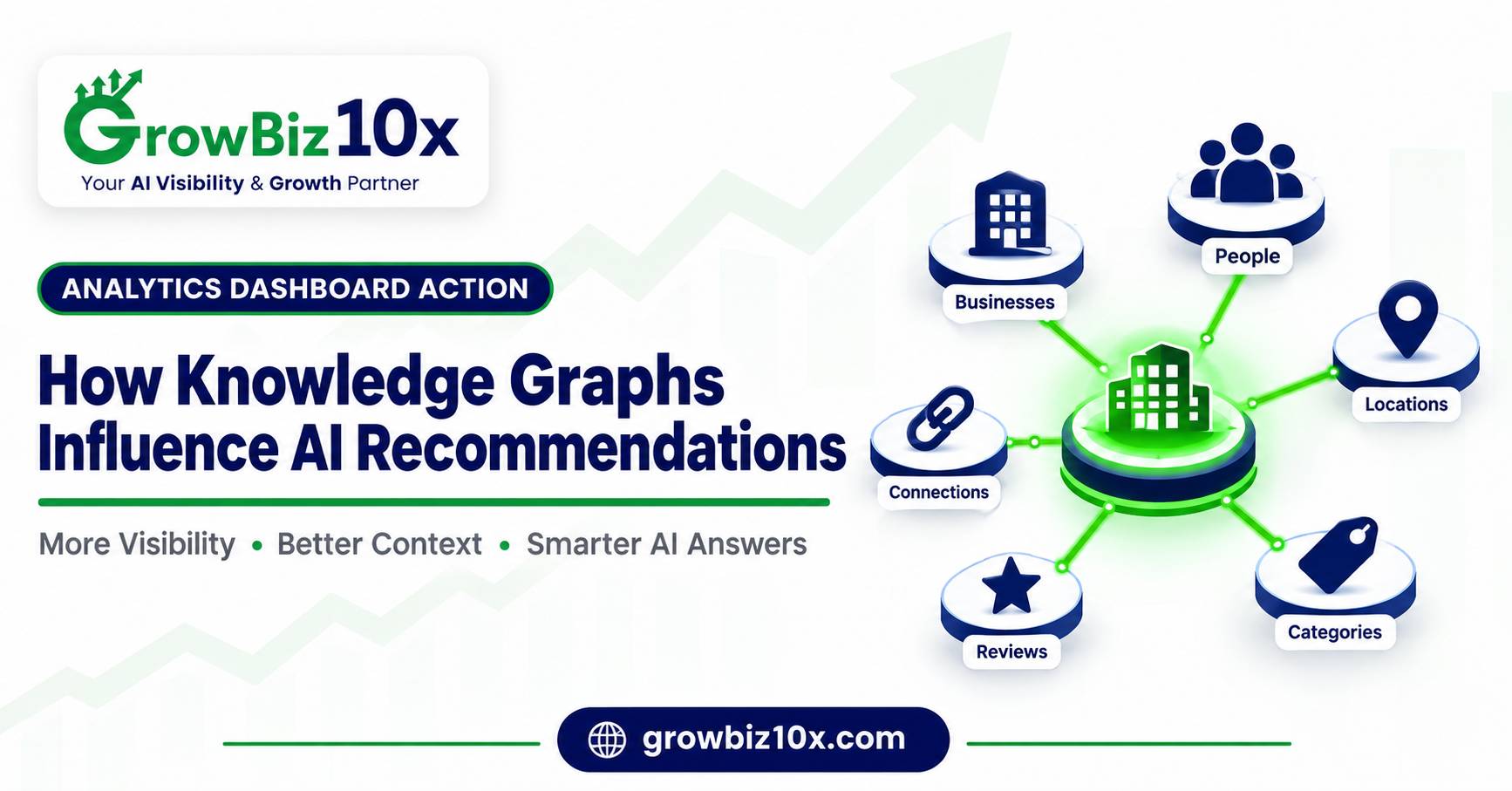
A knowledge graph is a structured database of entities and the relationships between them: this business offers this service, operates in this city, belongs to this industry, and is connected to these people. AI engines consult knowledge graphs to verify facts, distinguish similarly named businesses, and ground their answers in reliable data. A clean, accurate presence in the graphs engines rely on makes your business far easier to recommend.
What a Knowledge Graph Contains
Where a web page holds prose, a knowledge graph holds facts as connected triples: entity, relationship, value. Acme Roofing is located in Tampa. Acme Roofing was founded in 2009. Acme Roofing offers metal roof installation. This structure lets machines answer precise questions and traverse relationships, such as finding roofing companies in Tampa that handle metal roofs. Graphs are built by extracting facts from trusted sources, merging duplicates, and scoring confidence, which is why consistent public data flows directly into graph quality. The entities these graphs organize are explained in What Is an Entity and Why Does AI Care About Yours?.
The Graphs That Matter for Business Visibility
Google's Knowledge Graph powers knowledge panels and feeds Gemini and AI Overviews. Wikidata is an open, structured knowledge base that many AI systems and datasets draw from, and it underpins much of the entity data in the wider ecosystem. Microsoft's index and graph inform Copilot and Bing experiences. Map platforms and local data providers act as de facto graphs for local business facts. You rarely interact with these systems directly; you influence them through the sources they ingest.
How Graphs Shape AI Answers
Graphs influence answers at several points. During grounding, an engine can check a generated claim against graph facts and drop assertions that conflict. During disambiguation, graph identifiers separate your business from same-named companies. During retrieval, graph data enriches results with verified attributes such as hours, categories, and locations. And because graphs encode relationships, they help you surface for adjacent queries: an engine that knows you belong to a certification body or serve a particular suburb can recommend you for questions that never mention your name. These graph checks complement the live lookups described in Training Data vs Real-Time Retrieval: How AI Finds Business Information.
A Quick Example: Winning an Adjacent Query
Picture a physical therapy practice that has done its graph homework: a complete Google Business Profile listing sports rehabilitation among its services, LocalBusiness schema on its site with sameAs links to its profiles, and identical facts across the major directories. The graph now holds reliable connections: the practice offers sports rehabilitation, serves the Northgate area, and belongs to the physical therapy category. When someone asks an assistant for help recovering from a running injury near Northgate, no page on the practice's website targets that exact phrase, but the engine can still connect the query to the practice by traversing relationships: running injuries relate to sports rehabilitation, and Northgate falls inside the service area. A practice with the same website but no structured, corroborated facts gives the engine nothing to traverse, and misses the question entirely.
Getting Your Business Into the Graphs
- Complete and actively maintain Google Business Profile and Bing Places
- Add Organization or LocalBusiness schema with sameAs links connecting your identities
- Ensure your facts match exactly across your site, listings, and major directories
- Create or improve a Wikidata item if your business has citable references
- Earn coverage in sources graphs trust, such as news outlets and official registries
Maintain It: Graphs Reward Consistency Over Time
Graph builders score confidence based on agreement among sources and stability over time. A burst of contradictory updates, an address that differs across listings, or an abandoned profile erodes that confidence. Set a quarterly routine: verify your core facts everywhere they appear, update seasonal details, and correct third-party errors quickly. Slow, steady consistency is exactly what graph systems are designed to reward.
Frequently Asked Questions
Do I need a Wikipedia article to be in a knowledge graph?
No. Wikipedia helps enormously for notable organizations, but graphs ingest many other sources: business profiles, structured site markup, official registries, and Wikidata, which has a lower bar than Wikipedia. Most small businesses build graph presence without ever having a Wikipedia article.
How long does it take to appear in Google's Knowledge Graph?
There is no fixed timeline. Consistent data, structured markup, and independent corroboration typically produce results over months rather than days. A knowledge panel appearing when someone searches your brand is a visible sign the graph has resolved your entity.
Can I fix wrong information in a knowledge graph?
Yes, indirectly and sometimes directly. Correct the source data first: your listings, your site markup, and major directories. Google allows suggested edits on knowledge panels, and verified owners can claim them. Wikidata can be edited directly with cited references.
Related reading
- How AI Engines Decide Which Businesses to Recommend
- Do Directories and Wikipedia Still Matter for AI Visibility?
- What Sources Do AI Engines Trust When Recommending Businesses?
- How Structured Data Helps Search Engines Understand Your Business
Get on the Graph
Knowledge graphs are the connective tissue between your public data and AI recommendations. Feed them consistent, verifiable facts and they quietly advocate for your business in every answer that draws on them. GrowBiz10x checks how graphs and engines currently represent your business, finds the inconsistencies holding you back, and gives you a fix list ordered by impact. Start your free scan at growbiz10x.com.
Want to see how your business performs across AI platforms?
Get a free AI visibility audit and personalized insights for your brand.
About the Author
GrowBiz10x Team
AEO SpecialistWe share actionable insights on AI visibility, content strategy, and digital growth to help businesses get discovered and grow faster.
Related Posts
Categories
- Commercial / Agency / GrowBiz10x20
- Industry-Specific10
- Measuring AI Visibility10
- Practical AEO/GEO10
- SEO vs AEO vs GEO10
- Brand Signals & Authority10
- How AI Understands & Recommends Businesses10
- The Search Shift10
- Pillar: AI Visibility10
Get the latest insights in your inbox.
Subscribe to our newsletter and never miss an update.