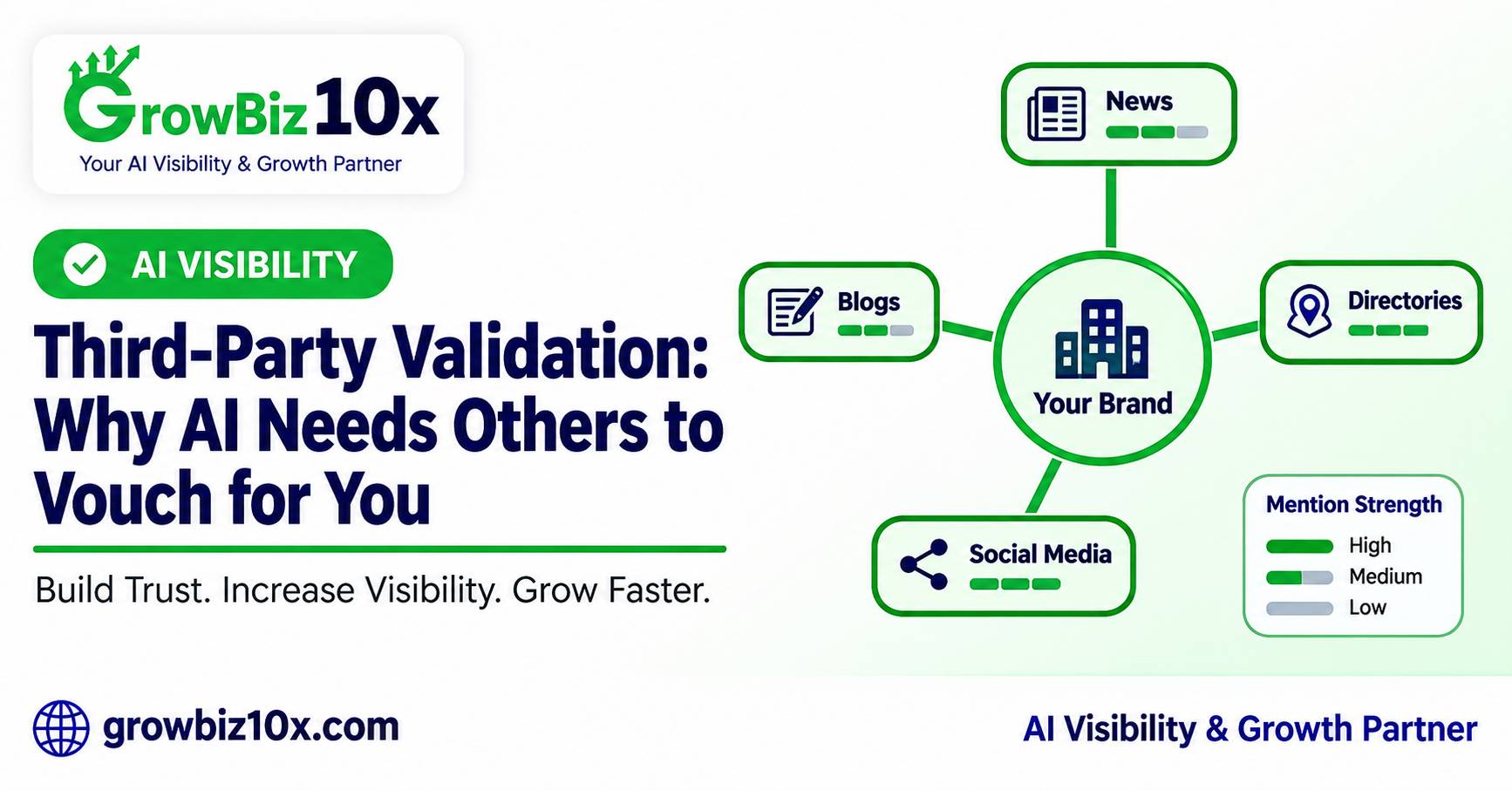
Third-party validation is independent confirmation of your claims from sources you do not control: press, directories, review platforms, certifiers, partners, and other websites. AI engines need it because they cannot take your word for your own excellence; before recommending anyone, they triangulate what independent sources say. Understanding this changes your marketing priorities: what others publish about you now matters as much as what you publish about yourself.
Why AI Discounts What You Say About Yourself
Every business website says the business is excellent, which means self-description carries almost no differentiating information. AI engines are built to be trusted by their users, so they behave like careful referees: your claims set the hypothesis, and independent sources confirm or deny it. When your site says you are a leading provider and no external source agrees, the claim evaporates. When a trade publication, forty reviewers, a certification body, and two best-of lists all point the same direction, the engine has something it can safely repeat. Validation is not vanity; it is the verification layer AI runs before recommending you.
The Types of Validation AI Engines Weigh
- Editorial mentions: articles and news coverage that name your business in context.
- Best-of lists and comparison roundups in your category and city.
- Customer reviews on independent platforms, in volume and with detail.
- Licenses, certifications, and accreditations that a third party actually maintains.
- Memberships in recognized industry associations and chambers.
- Awards with credible selection processes.
- Partner, vendor, and client pages that list your business.
- Citations of your content or experts by other credible sites.
No single type is mandatory. Engines look for a converging pattern from several directions.
How to Get Included in Lists and Directories
Best-of lists are among the most quoted sources in AI recommendations, so treat inclusion as a campaign. Find every credible list and directory for your category and area, from industry rankings to local roundups. Check the inclusion criteria: many are maintained by writers who welcome well-documented suggestions, and others require a profile, an application, or membership. Reach out with a short factual case for why you belong, backed by the evidence they care about: reviews, years in business, credentials, notable work. Skip pay-to-play schemes with no editorial standards; engines learn which sources are credible, and so do customers. See Do Directories and Wikipedia Still Matter for AI Visibility?.
Awards, Certifications, and Memberships That Count
Credentials work as validation when a third party genuinely stands behind them and there is a public record to verify. Prioritize industry certifications with real requirements, licenses your field respects, and association memberships that maintain public member directories, because a checkable listing is itself a citation confirming your identity. Then make each credential legible: display it on your About page with the issuing body and date, and keep your entry in the issuer's directory current. A credential the web cannot verify is a claim; a credential with a public record is proof.
Turn Validation Into a Flywheel
Validation compounds when you connect the pieces. Each new proof point, a press mention, an award, a certification, belongs on your About page and in your schema markup, strengthening the entity record engines read. Publicize wins through your own channels and local media, which often triggers further coverage. Reference your credentials when pitching commentary, which earns editorial mentions, which strengthen your case for the next list inclusion. Businesses that manage validation deliberately build a self-reinforcing evidence trail; businesses that treat it as luck stay invisible to the engines doing the checking. Earning them steadily is the work of digital PR for AI visibility.
A Worked Example: Building a Validation Flywheel
Picture a hypothetical managed IT services firm with no outside validation. First it joins the local chamber and two vendor partner directories, each adding a public, checkable listing. Next it earns a place on a regional best-of list for IT support and links the badge on its site back to the list. Later a partner features the firm in a joint case write-up, and the founder is quoted in a trade article about backup planning. Each proof point lands on the About page, reinforced with schema, so engines connect every mention to one entity. No single item impresses alone; the converging pattern changes the verdict.
Frequently Asked Questions
What if my industry has few directories or lists?
Go local and adjacent. Chamber memberships, local business journals, city best-of roundups, and partner pages all provide independent confirmation regardless of industry. You can also create the occasion for coverage by publishing useful original insight that others in your field want to reference.
Are paid directory listings worth anything?
Some are, if the directory has editorial standards, real traffic, and a reputation engines and customers respect. A paid listing in a category-defining industry directory can be solid validation. A paid spot on a site that lists anyone who pays adds nothing and can associate you with low-quality neighborhoods of the web.
How do AI engines verify certifications and awards?
Through corroboration. When your site claims a credential and the issuing body's public directory, a press release, or the award announcement confirms it, the claim is validated. This is why keeping your listings current with issuers matters as much as earning the credential in the first place.
Related reading
- How to Build an Entity Foundation for Your Business
- How Customer Reviews Build AI Trust in Your Brand
- Why AI Recommends Your Competitors Instead of You
Conclusion: Let the Web Testify for You
In AI search, the strongest voice in the room is never your own; it is the chorus of independent sources confirming what you claim. Build that chorus deliberately: earn the mentions, secure the listings, maintain the credentials, and wire every proof point into your entity record. GrowBiz10x maps the third-party signals AI engines currently find for your business, benchmarks them against competitors, and shows you which missing validations would move answers. Get your validation gap analysis from GrowBiz10x and give AI engines every reason to vouch for you.
Want to see how your business performs across AI platforms?
Get a free AI visibility audit and personalized insights for your brand.
About the Author
GrowBiz10x Team
AEO SpecialistWe share actionable insights on AI visibility, content strategy, and digital growth to help businesses get discovered and grow faster.
Related Posts

Categories
- Commercial / Agency / GrowBiz10x20
- Industry-Specific10
- Measuring AI Visibility10
- Practical AEO/GEO10
- SEO vs AEO vs GEO10
- Brand Signals & Authority10
- How AI Understands & Recommends Businesses10
- The Search Shift10
- Pillar: AI Visibility10
Get the latest insights in your inbox.
Subscribe to our newsletter and never miss an update.