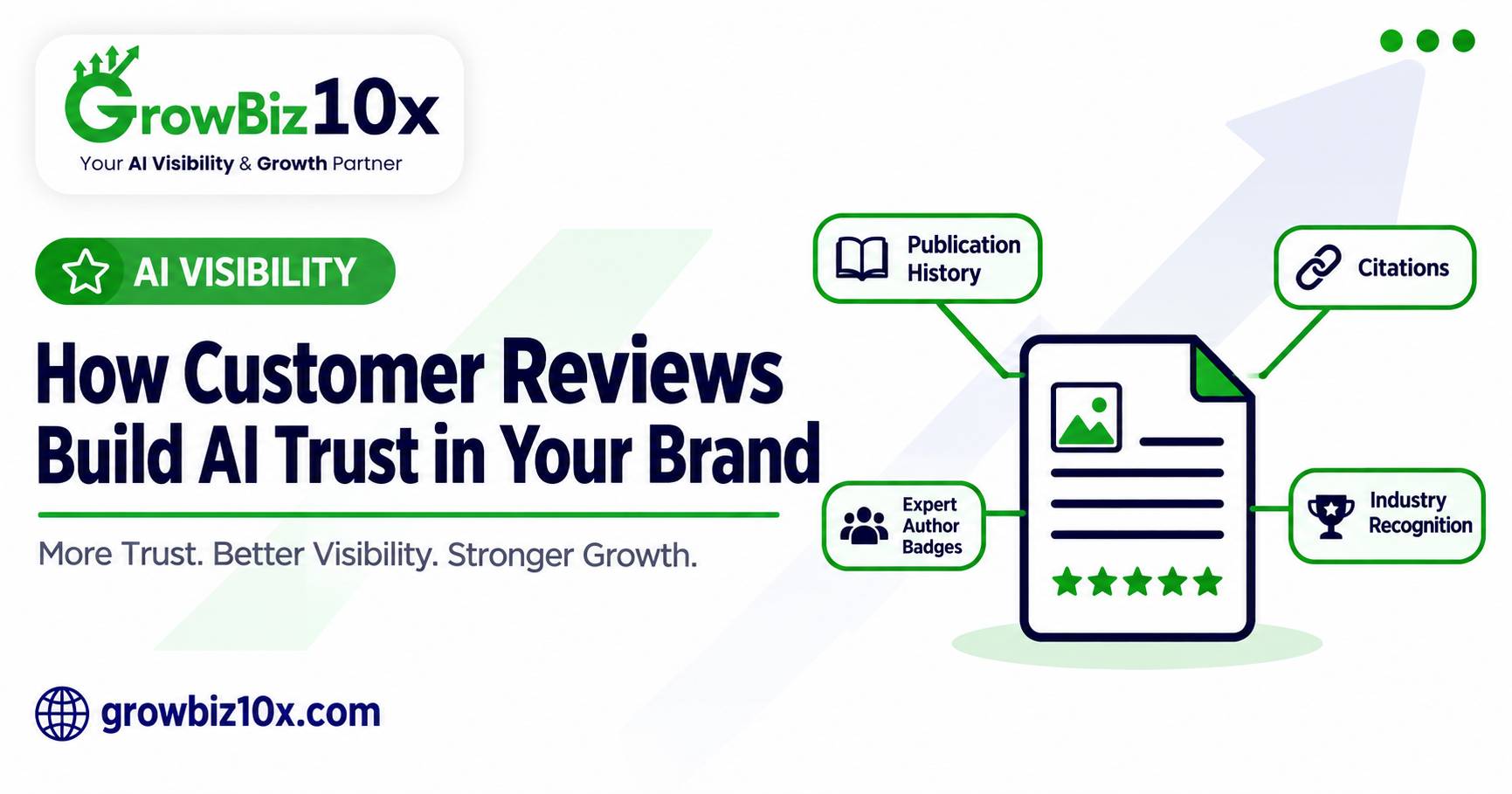
Customer reviews build AI trust because they are independent, dated, detailed evidence of how your business actually performs, exactly the kind of third-party signal answer engines weigh when deciding whom to recommend. A steady flow of genuine reviews across trusted platforms tells AI systems that real people repeatedly vouch for you. For many SMBs, reviews are the single strongest trust asset they already have, and the most underused.
How AI Engines Use Reviews
Answer engines do more than average your stars. They read review text to learn what you are actually good at, which services customers mention, and how you handle problems. They weigh volume as evidence of an active business, recency as evidence you are still delivering, and consistency across platforms as evidence the pattern is real. When someone asks an AI engine for the best provider near them, the language inside your reviews often supplies the very phrases the engine uses to describe and justify recommending you. Reviews are not just ratings; they are training data about your brand. This is part of the broader role of reviews and reputation in AI recommendations.
The Review Platforms That Matter Most
Concentrate where engines and your customers already look:
- Google Business Profile, the highest-leverage platform for almost every local and service business.
- The dominant review site in your industry, such as G2 or Capterra for software, Houzz for home services, or TripAdvisor for hospitality.
- Broad consumer platforms like Yelp, Trustpilot, or Facebook where your buyers are active.
- Professional platforms such as LinkedIn recommendations for B2B service firms.
Depth on two or three relevant platforms beats a thin presence on ten.
How to Earn More Reviews the Right Way
The businesses with strong review profiles are rarely luckier; they simply ask better. Ask at the moment of satisfaction, right after a successful delivery, project completion, or support resolution. Make it effortless with a direct link or QR code to the review form. Build the ask into your process, whether that is a follow-up email sequence or a line in your handoff script, so it happens every time rather than when someone remembers. Encourage customers to mention the specific service they used, since detailed reviews teach engines more than star-only ratings. Never buy reviews, never post fakes, and never selectively gate unhappy customers away from public platforms; those shortcuts violate platform rules and poison the very trust you are building.
Respond to Every Review, Especially Critical Ones
Responses are trust signals in their own right. A thoughtful reply to a negative review, acknowledging the problem, explaining the fix, and staying professional, shows engines and prospects an accountable business. Silence, or a defensive blast, shows the opposite. Respond to positive reviews too, briefly and personally, because a pattern of engagement signals an operation that pays attention. AI engines summarizing your reputation can draw on how you respond, not just what reviewers say.
Bring Review Signals Onto Your Own Site
Your website should reflect the reputation you have earned elsewhere. Publish detailed testimonials and case studies with the customer's permission, name, and context, and link out to your public review profiles. Where your platform allows it, use appropriate review or rating schema so machines can connect on-site praise to off-site proof. The goal is corroboration: what your site claims, your reviews confirm, and what your reviews say, your site reflects. That closed loop is what makes an AI engine comfortable repeating your reputation to its users. That alignment reinforces the signals described in E-E-A-T for AI Search.
A Worked Example: A Dental Practice Review Routine
Consider a hypothetical dental practice that treats reviews as a system. When an appointment ends well, the front desk sends a short text with a direct link to the practice's Google profile, and patients who mention a specific treatment are invited to describe it. The office manager replies to every review within two days, naming the specific detail rather than pasting a template, and answers the occasional critical review by acknowledging the issue and explaining the fix. Over a year the profile fills with dated, detailed accounts naming services like implants and pediatric cleanings. When an answer engine is asked about a dentist for a nervous child, that text is exactly the evidence it needs.
Frequently Asked Questions
Do AI engines read review text or just star ratings?
They read the text. Review content tells engines which services you excel at, what customers value, and whether problems get resolved. This is why detailed reviews that mention specific services are worth more to your AI visibility than a rating with no words attached.
How much do negative reviews hurt AI recommendations?
Less than most owners fear, if they are a small minority and handled well. A flawless wall of five-star reviews can even read as suspicious. A strong overall pattern with a few professionally addressed complaints looks like a real business, and real is what engines are trying to verify.
Which platform should I prioritize first?
For nearly every local or service business, Google Business Profile comes first because of its reach and its influence on AI answers. After that, pick the one review platform your industry and customers treat as the standard, and build depth there before spreading wider.
Related reading
- How to Build an Entity Foundation for Your Business
- Third-Party Validation: Why AI Needs Others to Vouch for You
- Measuring Sentiment: What AI Engines Say About Your Brand
Conclusion: Turn Happy Customers Into Trust Signals
You are already earning the raw material of AI trust every time you deliver good work; reviews are how that work becomes visible, verifiable evidence. Ask consistently, respond professionally, and connect the proof to your site. GrowBiz10x monitors how your review footprint shapes what AI engines say about your brand and shows you exactly where more proof would change the answer. See how AI engines read your reputation with GrowBiz10x and put your happiest customers to work.
Want to see how your business performs across AI platforms?
Get a free AI visibility audit and personalized insights for your brand.
About the Author
GrowBiz10x Team
AEO SpecialistWe share actionable insights on AI visibility, content strategy, and digital growth to help businesses get discovered and grow faster.
Related Posts

Categories
- Commercial / Agency / GrowBiz10x20
- Industry-Specific10
- Measuring AI Visibility10
- Practical AEO/GEO10
- SEO vs AEO vs GEO10
- Brand Signals & Authority10
- How AI Understands & Recommends Businesses10
- The Search Shift10
- Pillar: AI Visibility10
Get the latest insights in your inbox.
Subscribe to our newsletter and never miss an update.