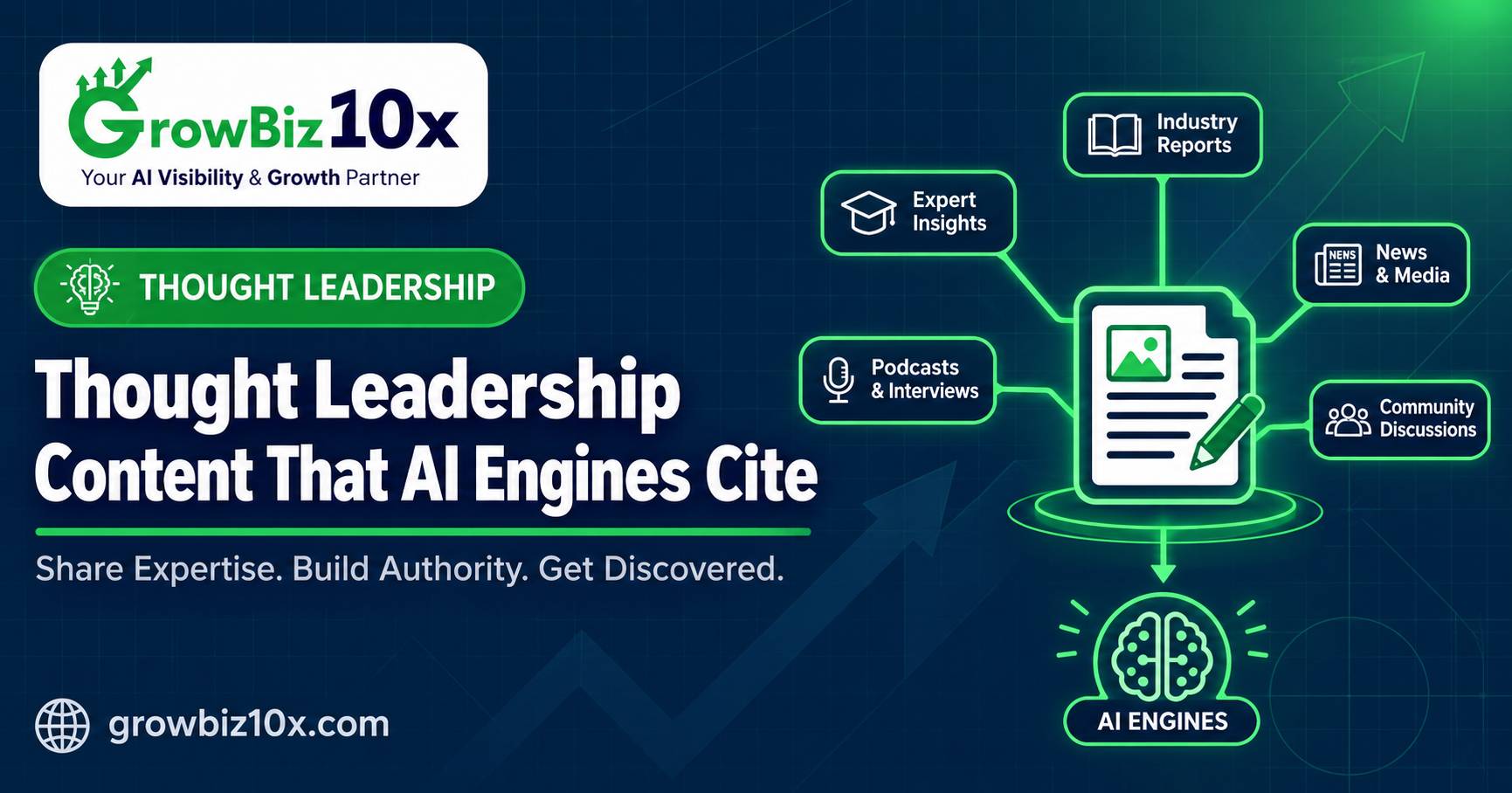
Thought leadership content that AI engines cite offers original, clearly attributed insight: a definite point of view, first-hand evidence, and quotable statements that answer real questions. Engines cite it because it gives them something they cannot get elsewhere, a specific claim from a named expert they can attribute. Generic advice, no matter how polished, gets absorbed and forgotten; original insight gets credited.
What Makes Content Citable to an AI Engine
When an answer engine assembles a response, it needs sources that add something beyond the consensus. Citable content has three properties. It is original: a claim, framework, or observation that does not appear on a thousand other sites. It is attributable: a named expert and business stand behind it, so the engine can say who thinks this. And it is extractable: the key idea lives in a clean, self-contained passage the engine can quote without dragging along context. Most content marketing fails all three tests at once, which is why most content never earns a citation.
Formats AI Engines Quote Most Often
Some formats are structurally easier for engines to lift and credit:
- Definition-style explainers that give a crisp answer to a recurring question in your field.
- Named frameworks and methodologies your business developed, described step by step.
- Small original datasets and benchmarks drawn from your own operations.
- Well-argued positions on debates in your industry, with the reasoning shown.
- Expert FAQ pages that answer the questions customers actually ask AI.
- Annual state-of-the-industry observations from your vantage point.
Create Original Insight Without a Research Budget
You do not need a research department; you need to treat your daily work as data. Patterns across your customer base, the mistakes new clients arrive with, how requests have shifted over the seasons, what a typical project really costs and why: these observations are original by definition, because only you have your vantage point. Name your recurring methods so they become referenceable concepts. Keep a running file of surprising things you learn on real jobs. One genuinely original observation, clearly explained, outperforms ten summaries of what everyone already agrees on.
Structure Ideas So Machines Can Lift Them
Citability is partly an editing discipline. Lead each piece with the core claim in the first two sentences instead of building to it. Keep one idea per paragraph, phrased so it survives being quoted alone. Use headings that mirror real questions, and put the direct answer immediately beneath them. Attribute clearly: a byline, a short credential line, and consistent naming of the same expert across pieces so engines learn who your voice is. When you state something bold, follow it with the evidence, because engines prefer claims they can see supported. The same principles power how to optimize content for AI answers.
Distribute Where AI Engines Are Listening
Publish the definitive version on your own site first, anchored to your entity and your expert's bio. Then extend its reach: adapt the argument for LinkedIn where industry conversation happens, offer versions or commentary to trade publications, and bring the ideas to podcasts, where transcripts turn your speech into indexable text. When other sites reference your framework or quote your expert, the idea stops being something you said and becomes something the industry says you said. That independent echo is what turns a good article into a source engines treat as citable. Distribution is also where digital PR for AI visibility earns its keep.
A Worked Example: Field Notes Become a Citable Claim
Imagine the owner of a commercial cleaning company who notices a pattern across client walkthroughs: most contract disputes trace back to unclear scope, not poor work. She turns that observation into a short piece with the claim stated in the first two sentences, then walks through a three-part scope checklist that prevents the problem, drawing on examples from the field. The article carries her name and links her bio, giving the insight the kind of rooted specificity that building topical authority depends on. A trade newsletter picks it up and a facilities podcast invites her on, so the claim starts appearing where engines listen. When an answer engine assembles guidance on cleaning contracts, her framework is liftable, attributed, and original, which is exactly what earns the citation.
Frequently Asked Questions
Can local and small businesses do thought leadership?
Yes, and often more credibly than large firms. A local roofer explaining what a decade of storm repairs reveals about regional building shortcuts is original insight no national publisher can match. Specific, grounded expertise is exactly what engines struggle to find and love to cite.
Should thought leadership be published under a person or the brand?
Lead with a person, connected to the brand. Engines and readers both find named human experts more credible than corporate voices, and a consistent byline builds an expert entity over time. Use author bios and schema to bind the person to the business so citations benefit both.
How do I know if AI engines are citing my content?
Ask them. Regularly query the major answer engines with the questions your content addresses and note whether your business or experts appear, how ideas are attributed, and which competitors are cited instead. Tracking this over time shows you which pieces earn citations and what to write next.
Related reading
- How to Build an Entity Foundation for Your Business
- E-E-A-T for AI Search: Building Trust Signals AI Can Verify
- How Citations and Brand Mentions Shape AI Answers
Conclusion: Say Something Worth Attributing
AI engines have infinite access to conventional wisdom; what they lack is your vantage point. Publish specific claims from named experts, structure them for clean extraction, and put them where engines listen. Do it consistently and your business becomes a source, not just a site. GrowBiz10x tracks which questions AI engines answer in your niche, who they currently cite, and where your insight could take the spot. Find your citation opportunities with GrowBiz10x and start becoming the expert AI quotes.
Want to see how your business performs across AI platforms?
Get a free AI visibility audit and personalized insights for your brand.
About the Author
GrowBiz10x Team
AEO SpecialistWe share actionable insights on AI visibility, content strategy, and digital growth to help businesses get discovered and grow faster.
Related Posts

Categories
- Commercial / Agency / GrowBiz10x20
- Industry-Specific10
- Measuring AI Visibility10
- Practical AEO/GEO10
- SEO vs AEO vs GEO10
- Brand Signals & Authority10
- How AI Understands & Recommends Businesses10
- The Search Shift10
- Pillar: AI Visibility10
Get the latest insights in your inbox.
Subscribe to our newsletter and never miss an update.