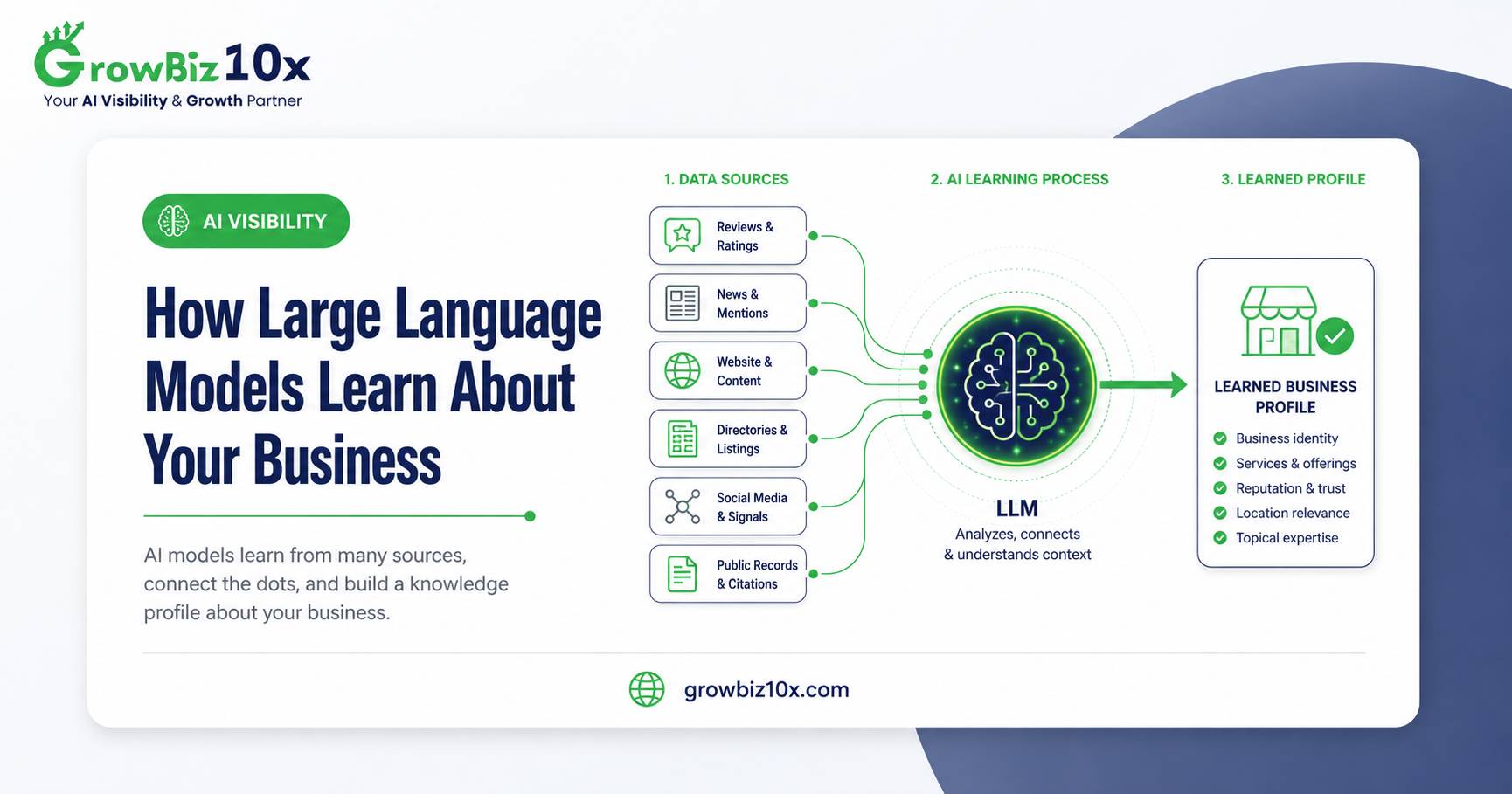
Large language models learn about your business by processing enormous amounts of public text during training: web pages, articles, directories, reviews, and reference material. The model does not save a copy of your website; it learns statistical associations between your name and the words that appear around it. If the public web consistently describes you as a trusted bookkeeping firm in Denver, the model absorbs that association and can reproduce it when someone asks for bookkeeping help.
Pretraining: Learning From a Snapshot of the Web
Before release, a model goes through pretraining, where it learns to predict text across a massive corpus collected up to a cutoff date. In doing so it absorbs facts, relationships, and reputations as patterns rather than records. Businesses that appear often, in many independent contexts, leave a strong imprint. Businesses mentioned rarely, inconsistently, or only on their own site leave a faint one. This is why two companies of similar quality can have wildly different AI visibility: the model simply learned more about one of them. Which sources leave the deepest imprint is the subject of What Sources Do AI Engines Trust When Recommending Businesses?.
Associations, Not a Database
It helps to picture the model's knowledge as a web of weighted associations rather than a filing cabinet. Ask about accountants in your city and the model surfaces the business names most strongly associated with that category and place. Strength comes from frequency and consistency. If half the web says you are a marketing agency and the other half says you are a print shop, the association splits and weakens, and the model may hedge, get it wrong, or leave you out entirely.
A Quick Example: Two Bakeries, Two Imprints
Consider two bakeries of equal quality. Rise and Shine is described the same way on its website, its Google Business Profile, a food blog roundup, and dozens of reviews: a family bakery known for sourdough and custom cakes in the Riverside district. Doughy Delights has the same strengths, but its listings variously call it a cafe, a bakery, and a dessert shop, its reviews rarely say more than great place, and its only detailed description sits on its own homepage. A model reading the public web during training builds one strong, specific association for Rise and Shine and a weak, scattered one for Doughy Delights. When someone later asks for a sourdough bakery near Riverside, only one of the two names surfaces with confidence. Same ovens, different imprints, different visibility.
Knowledge Cutoffs and Stale Facts
Every model has a training cutoff, and anything that changed afterward is invisible to the model's memory. If you rebranded, moved, or launched a new service recently, the base model may still describe the old version of your business. New model versions retrain on fresher data, so keeping your public footprint accurate today is how you shape what the next generation of models knows. Meanwhile, retrieval features can bridge the gap by reading your current pages at answer time.
Fine-Tuning and Retrieval Complete the Picture
After pretraining, models are fine-tuned to be helpful, safe, and conversational. This stage rarely adds business facts; it shapes behavior. The bigger practical factor is retrieval-augmented generation, where an engine searches the web mid-answer and reads current pages into its context. That means you have two levers. Your accumulated public footprint determines what the model already believes, and your current, crawlable, well-structured pages determine what it finds when it looks. We compare these two levers in Training Data vs Real-Time Retrieval: How AI Finds Business Information.
How to Make Your Business Easy to Learn
- Describe your business the same way everywhere: same name, category, and one-line summary
- Earn mentions on public, crawlable pages such as news sites, blogs, and directories
- Keep a steady flow of reviews with specific details about your services
- Avoid making gated platforms your only presence, since closed content may never reach training data
- Refresh outdated listings so future training runs capture the current facts
Frequently Asked Questions
Can I submit my business directly to a language model?
No. There is no submission channel into model training. You influence what models learn indirectly, by shaping the public text they train on. On the retrieval side, standard tools such as search engine webmaster consoles help ensure your current pages are indexed and findable.
Why does an AI describe my business incorrectly?
Usually because its training data contained outdated or conflicting information, or because retrieval surfaced a stale listing. Audit what the major engines say about you, trace each error to its likely source, and correct the source. AI answers follow the underlying data over time.
Should I block AI crawlers from my website?
For most businesses seeking customers, blocking training or retrieval crawlers works against you: you disappear from what models learn and from what engines can read. Publishers with paywalled content face a different tradeoff, but SMBs generally benefit from being fully crawlable.
Related reading
- How AI Engines Decide Which Businesses to Recommend
- What Is an Entity and Why Does AI Care About Yours?
- How Knowledge Graphs Influence AI Recommendations
- How Consistent Business Information Improves AI Visibility
Teach the Models Who You Are
You cannot upload facts into a language model, but you can make yourself unmissable in the text it learns from and the pages it retrieves. That is a marketing discipline, and it is measurable. GrowBiz10x audits what AI engines currently know about your business, flags the gaps and errors, and gives you a plan to fix them at the source. Check your AI visibility at growbiz10x.com and see what the models have learned about you.
Want to see how your business performs across AI platforms?
Get a free AI visibility audit and personalized insights for your brand.
About the Author
GrowBiz10x Team
AEO SpecialistWe share actionable insights on AI visibility, content strategy, and digital growth to help businesses get discovered and grow faster.
Related Posts

Categories
- Commercial / Agency / GrowBiz10x20
- Industry-Specific10
- Measuring AI Visibility10
- Practical AEO/GEO10
- SEO vs AEO vs GEO10
- Brand Signals & Authority10
- How AI Understands & Recommends Businesses10
- The Search Shift10
- Pillar: AI Visibility10
Get the latest insights in your inbox.
Subscribe to our newsletter and never miss an update.