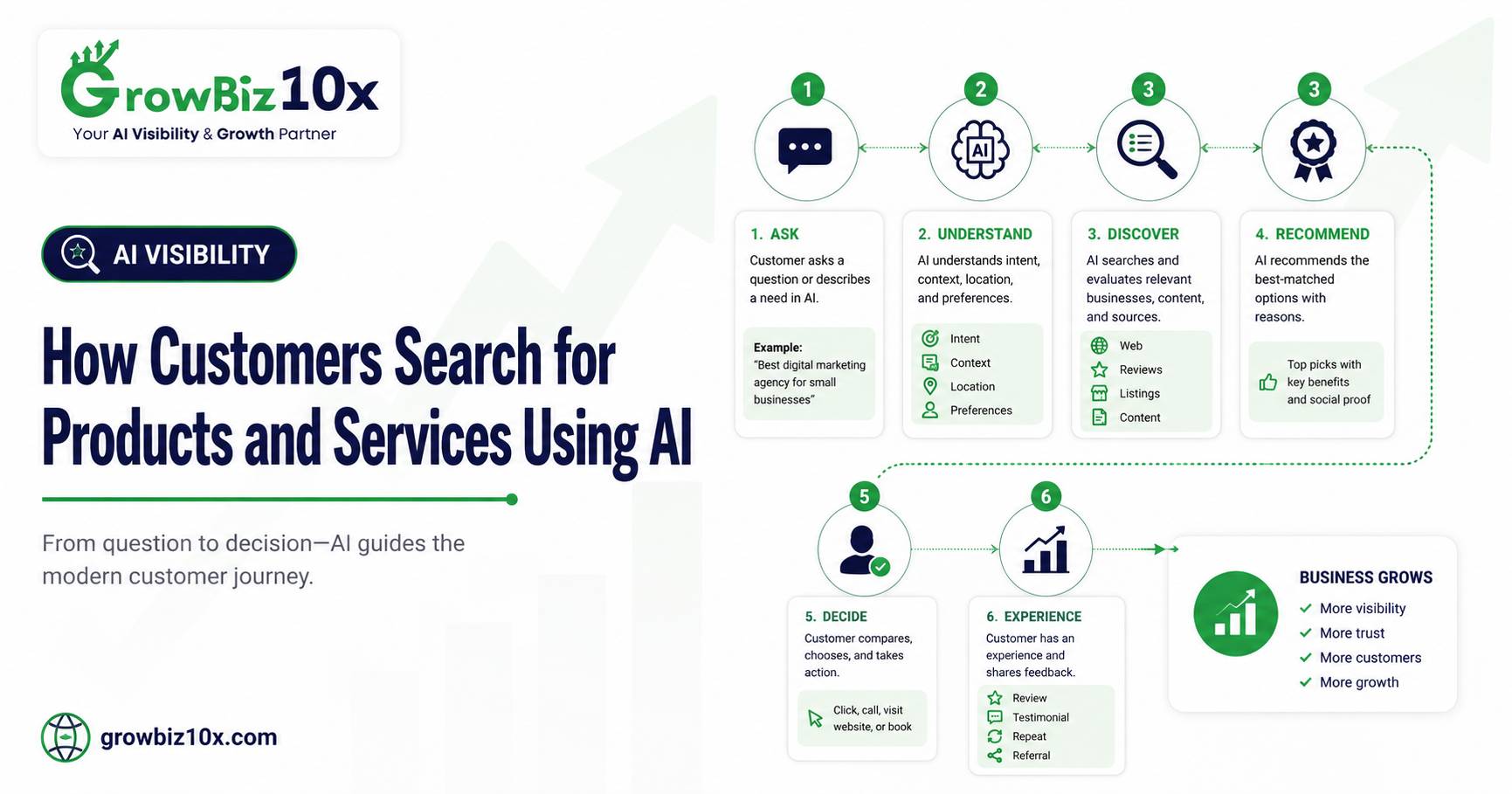
Customers search with AI by asking conversational questions that describe what they need, why they need it, and what constraints matter, then refining the answer through follow-ups. Instead of typing two or three keywords and scanning links, they hand the whole task to the assistant: compare these options, fit this budget, recommend one. Understanding these patterns is the first step to showing up inside the answers customers actually see.
From Keywords to Conversations
A Google-era search compresses a complicated need into fragments like crm small business. The same person using ChatGPT writes something closer to a brief: they run a five-person consulting firm, they need a CRM that integrates with their email, and they do not want to spend more than a modest monthly amount. AI search invites full sentences because full sentences get better answers. For businesses, that means the queries you should care about are no longer keyword lists but complete questions with context attached.
The Five Patterns of AI Search Behavior
Watch people use AI assistants for buying decisions and the same behaviors appear again and again:
- Context loading: users describe their situation before asking for options, giving the AI criteria to filter with
- Delegated comparison: instead of researching options themselves, users ask the AI to compare and rank them
- Iterative refinement: follow-up messages narrow the list, such as asking which option is cheapest or closest
- Validation checks: users paste in a business name and ask whether it is reputable
- Decision requests: at the end, many users simply ask which one they should choose
Each step is an opportunity to be included or excluded. A business that is easy for the model to describe accurately survives more rounds of filtering.
Example: A Five-Message Path to a Shortlist
Here is how the five patterns combine in practice. A homeowner starts with context loading: we are renovating a 1970s house, we need a landscaping company that handles drainage, and we want the work done before spring. The assistant suggests four local firms. Delegated comparison follows: which of these handles drainage problems best? Iterative refinement narrows further: which two are most affordable? Then a validation check: is the top pick licensed and well reviewed? Finally the decision request: which one should we call? Five messages, one recommendation, and a set of businesses that were never mentioned at any step. The same arc appears when people use ChatGPT instead of Google to find businesses in categories from software to catering.
Multi-Turn Search Changes What Content Wins
Because AI search is a dialogue, the winning content is not a page stuffed with keywords but information that answers layered questions. When a user drills from a broad category down to pricing, availability, and differentiators, the assistant needs sources that cover those layers. Publish pages that state clearly what you offer, who it is for, how pricing works, and how you differ from alternatives. Plain, factual, well-organized content is what models quote when the follow-up questions arrive. Practical guidance on this lives in how to optimize content for AI answers.
Intent Is Richer, and Closer to Purchase
A customer who tells an AI their budget, timeline, and requirements is deep into a buying decision. AI search queries carry more intent than keyword searches ever did, and the people who eventually click through to a website have often finished most of their research. Treat AI-referred visitors as warm leads: make your site confirm what the AI said, surface proof quickly, and offer a clear next step rather than a generic homepage tour.
How to Optimize for AI Search Patterns
Start by collecting the real questions customers ask, from sales calls, support tickets, and chat logs, and answer them one by one on your site in direct language. Structure pages with descriptive headings so each answer stands alone. Keep facts about your business consistent across the web so the model can connect the dots. Add FAQ content and schema markup where it fits. Then test: ask assistants the questions you optimized for and see whether your content shapes the answer. Well-structured question-and-answer pages help too; see how FAQs can improve AI search visibility.
Frequently Asked Questions
Do keywords still matter in AI search?
The concepts behind keywords still matter, because they signal what topics you should cover. What has changed is the format. Instead of repeating a phrase, you win by answering the full question that phrase implies, clearly enough for an AI to quote.
What kinds of purchases are people researching with AI?
Everything from software and professional services to restaurants, contractors, and travel. Considered purchases with many options benefit most from AI comparison, which is exactly where being part of the model's shortlist matters.
How is voice search related to AI search?
They overlap heavily. Voice queries are naturally conversational, and voice assistants increasingly draw on the same AI answer engines. Content optimized for conversational AI search generally performs well for voice too.
Related reading
- The Future of Search: From Blue Links to AI Recommendations
- How AI Search Is Changing the Buyer's Journey
- What Are Zero-Click AI Searches and Why Do They Matter?
- How AI Determines Whether a Business Is Relevant
Turn New Search Habits Into New Customers
Customers have changed how they search; the businesses that adapt their content first will be the ones AI keeps recommending. GrowBiz10x analyzes how answer engines see your business, shows you the questions where you are missing, and gives you a prioritized plan to fix it. Get your free AI visibility report at growbiz10x.com and start meeting customers inside the conversation.
Want to see how your business performs across AI platforms?
Get a free AI visibility audit and personalized insights for your brand.
About the Author
GrowBiz10x Team
AEO SpecialistWe share actionable insights on AI visibility, content strategy, and digital growth to help businesses get discovered and grow faster.
Related Posts

Categories
- Commercial / Agency / GrowBiz10x20
- Industry-Specific10
- Measuring AI Visibility10
- Practical AEO/GEO10
- SEO vs AEO vs GEO10
- Brand Signals & Authority10
- How AI Understands & Recommends Businesses10
- The Search Shift10
- Pillar: AI Visibility10
Get the latest insights in your inbox.
Subscribe to our newsletter and never miss an update.