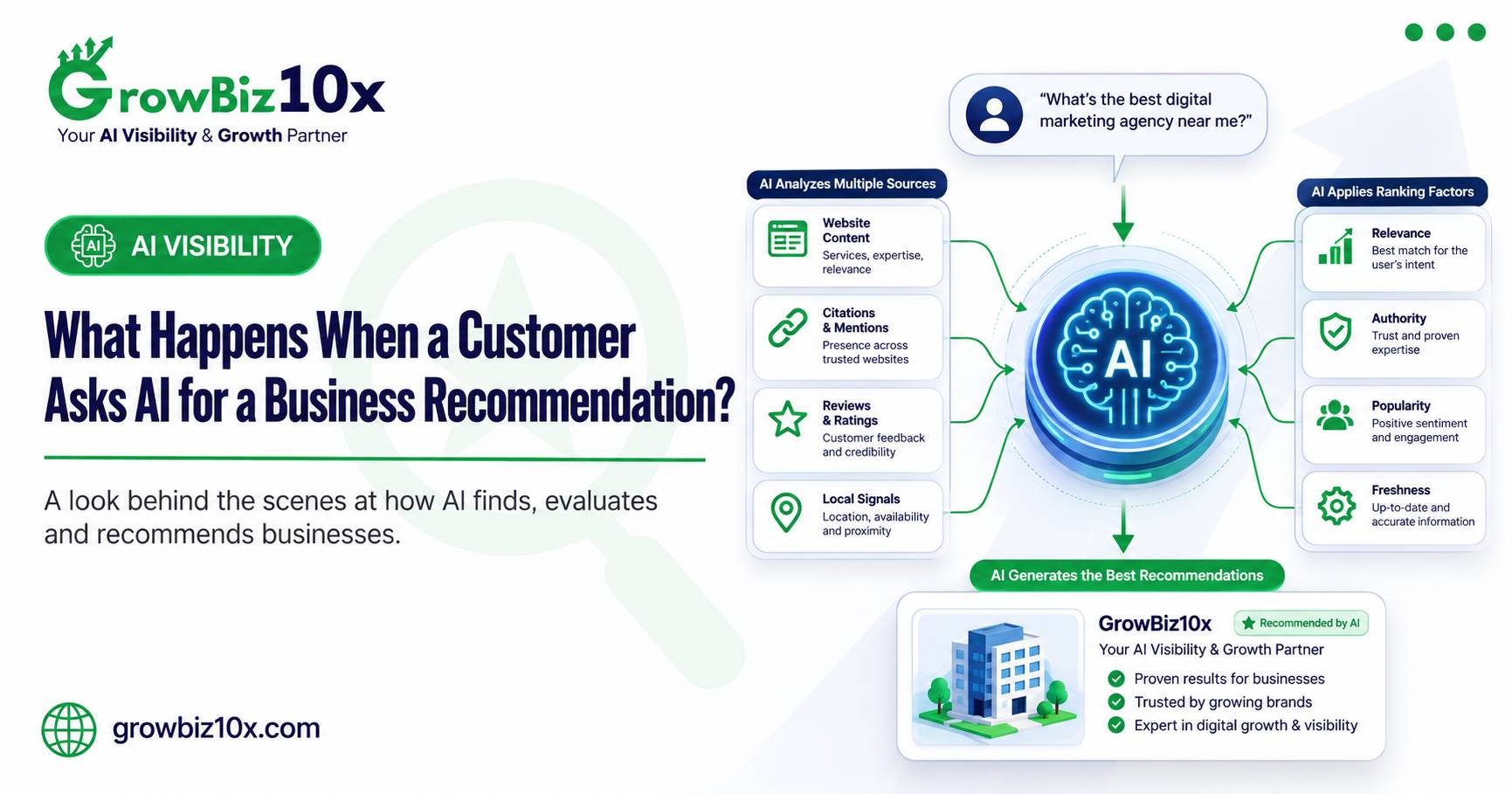
When a customer asks AI for a business recommendation, the model interprets the request, pulls together what it knows from training data and live sources, and synthesizes a short list of named businesses with reasons for each. The whole process takes seconds, and the factors that drive it are ones you can influence. Here is what happens behind the answer, step by step.
Step 1: The AI Interprets the Request
First the model parses intent. A question about the best CPA for a freelancer is unpacked into an entity type, a location if one is given or implied, and qualifying criteria such as specialty and price sensitivity. Ambiguity gets resolved by assumption or by a clarifying question. This is why specific, well-labeled business information matters: if your site clearly says who you serve and where, you fit cleanly into the criteria the model just extracted.
Step 2: It Gathers Candidate Information
Next comes retrieval. Depending on the tool, the answer draws on two pools. The first is training data: everything the model absorbed about businesses, brands, and reputations before its knowledge cutoff. The second is live retrieval: many assistants now search the web in real time, reading review sites, directories, articles, and business websites before composing an answer. Businesses with a strong presence in both pools, established mentions plus fresh crawlable content, have twice the surface area. The balance between these two pools is explored further in training data vs real-time retrieval.
Step 3: It Weighs Trust Signals
With candidates in hand, the model effectively asks which businesses it can safely recommend. The signals that matter are qualitative but consistent across platforms:
- Consistency: the same name, services, and details everywhere the business appears
- Reputation: reviews, ratings, and the sentiment patterns inside them
- Authority: mentions in credible third-party sources such as press, directories, and industry sites
- Clarity: business information that is easy to parse, including structured data
- Recency: signs the business is active, from updated content to recent reviews
No single signal decides the outcome. Models favor businesses that look reliable from several angles at once, because a wrong recommendation damages user trust in the assistant itself. For a deeper look at which outlets carry the most weight, see what sources AI engines trust when recommending businesses.
Step 4: It Synthesizes and Cites
Finally the model writes the answer: usually a handful of named options, each with a one-line rationale, sometimes with links or citations to the sources it used. Tools like Perplexity cite openly; others weave sources in silently. Either way, the businesses named owe their placement to the material the model could find and trust. If you were absent or unconvincing in the sources, you are absent from the answer.
Example: One Question, Four Steps, Three Names
Trace one realistic query through the pipeline: best family dentist near downtown Denver that offers weekend hours. Interpretation extracts the entity type, the location, and two criteria, family-friendly and weekend availability. Retrieval pulls candidate practices from directories, review platforms, and dental websites the assistant can read. Trust weighing quietly removes a practice whose listed hours conflict across sources and another with a thin, outdated site. Synthesis then names three practices, noting that one highlights Saturday appointments on its services page and carries consistently strong reviews. The practice that wins the mention did nothing exotic; it published clear hours, kept its listings consistent, and accumulated reviews. That is the playbook, and it matters even more as AI changes local business discovery.
How to Influence Each Step
You can work this pipeline deliberately. Make interpretation easy by stating plainly who you serve, what you do, and where. Feed retrieval by maintaining listings, earning mentions, and keeping your site crawlable and current. Strengthen trust signals with steady reviews and consistent facts. And make synthesis effortless by writing quotable summary passages, because the sentence you write about your business is often the sentence the AI repeats.
Frequently Asked Questions
Can I pay to be recommended by AI assistants?
Not in the organic answer. Some platforms are experimenting with sponsored placements, but the core recommendations are assembled from public information and trust signals. That is good news for businesses willing to do the visibility work.
Why does AI recommend my competitor and not me?
Usually because your competitor is easier to find, easier to parse, or better validated in the sources the model checked. Run the same prompt yourself, look at what gets cited, and compare your presence in those exact sources against theirs.
Do different AI tools recommend different businesses?
Yes. Training data, retrieval methods, and source preferences differ across ChatGPT, Gemini, Perplexity, and Claude, so recommendations vary. Testing across multiple assistants gives a truer picture of your AI visibility than checking one.
Related reading
- The Future of Search: From Blue Links to AI Recommendations
- How Customers Search for Products and Services Using AI
- How AI Search Is Changing the Buyer's Journey
- Why AI Recommends Your Competitors Instead of You
Get Into the Answer
Every AI recommendation is the end of a pipeline you can influence at every stage. GrowBiz10x maps how answer engines interpret, retrieve, and describe your business, then shows you exactly which signals to strengthen so your name comes out the other side. See what AI says about your business today with a free scan at growbiz10x.com.
Want to see how your business performs across AI platforms?
Get a free AI visibility audit and personalized insights for your brand.
About the Author
GrowBiz10x Team
AEO SpecialistWe share actionable insights on AI visibility, content strategy, and digital growth to help businesses get discovered and grow faster.
Related Posts

Categories
- Commercial / Agency / GrowBiz10x20
- Industry-Specific10
- Measuring AI Visibility10
- Practical AEO/GEO10
- SEO vs AEO vs GEO10
- Brand Signals & Authority10
- How AI Understands & Recommends Businesses10
- The Search Shift10
- Pillar: AI Visibility10
Get the latest insights in your inbox.
Subscribe to our newsletter and never miss an update.