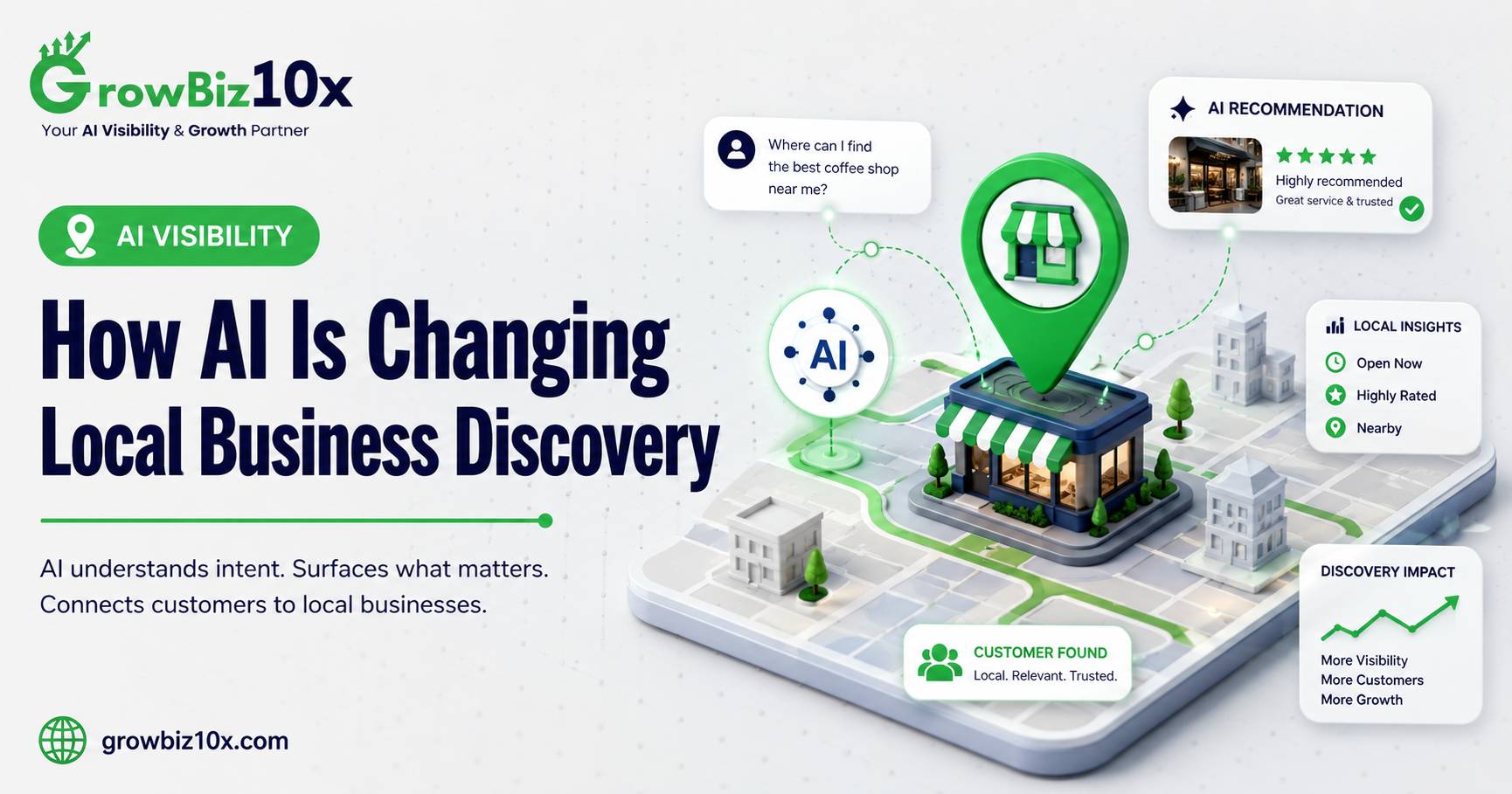
AI is changing local business discovery by turning searches like plumber near me into conversations that end with a few named businesses instead of a map full of pins. Assistants such as ChatGPT, Perplexity, and Google's AI features now answer local questions directly, drawing on reviews, listings, and web content to decide which companies to mention. For local businesses, visibility now depends on being the answer, not just appearing on the map.
From Map Packs to Direct Answers
For years, local discovery meant the Google map pack: three pins, star ratings, and a list of nearby options the customer would compare. AI answers compress that experience. When someone asks an assistant for a reliable electrician in their area, they often get two or three names with short explanations, not a ranked list of ten. The customer still makes the final call, but the AI decides which businesses even enter the conversation.
Where AI Gets Its Local Information
AI systems do not invent local recommendations. They assemble them from sources they can read and trust:
- Your website, especially service pages and location pages written in clear language
- Business profiles and directories, including Google Business Profile, Yelp, and industry-specific listings
- Reviews and the patterns inside them, such as recurring praise for speed or service
- Local media, blog mentions, and community sites that reference your business
- Structured data markup that spells out your name, address, hours, and services
If those sources disagree about your hours, address, or services, the model has a reason to skip you and recommend a business whose information is consistent.
How Local Search Questions Are Changing
Conversational queries carry far more detail than the old near me searches. Customers now ask for a dentist that takes their insurance and offers Saturday appointments, or a caterer that handles vegetarian menus for fifty people. That specificity is an opportunity: a business whose content clearly states what it offers, who it serves, and what makes it different gives AI exactly what it needs to match detailed requests. Generic descriptions get filtered out of specific questions.
Example: Two Plumbers, One Answer
Consider two plumbers in the same suburb. Plumber A has a website last touched years ago, three directory listings with two different phone numbers, and a handful of unanswered reviews. Plumber B lists identical details everywhere, publishes a page that plainly states emergency call-out areas and typical pricing, and answers every review. When a homeowner asks an assistant for an emergency plumber nearby who works weekends, the model can verify Plumber B's coverage, hours, and reputation in seconds, while Plumber A's conflicting details give it a reason to hesitate. Plumber B gets named; Plumber A gets skipped. Multiply that by every local query in your category and the stakes become obvious. For a closer look at the machinery behind this choice, read what happens when a customer asks AI for a business recommendation.
What Local Businesses Should Do Now
The fundamentals of local SEO still matter, but a few priorities move up the list. First, audit your information everywhere it appears and make it identical, from your website footer to every directory. Second, rewrite service pages to answer real questions, including pricing context, service areas, and specialties. Third, treat reviews as content: encourage them, respond to them, and let them accumulate detail about what you do well. Fourth, add local business schema so machines can parse your key facts without guessing. Finally, ask AI assistants for recommendations in your category and city, see whether you appear, then work the gaps. Consistency work pays off double, as we explain in how consistent business information improves AI visibility.
Measuring Local AI Visibility
You cannot manage what you never look at. Build a simple habit of testing the questions your customers ask, in the assistants they use, and recording the results. Note which competitors get named, which sources the AI cites, and how your business is described when it does appear. Over time this becomes a scoreboard for local AI visibility, the same way rank tracking became one for classic local SEO. When you are ready to formalize the habit, how to measure AI visibility for your business walks through a simple framework.
Frequently Asked Questions
Does Google Business Profile still matter in the AI era?
Yes, more than ever. AI systems lean heavily on established structured sources, and your Google Business Profile is one of the strongest signals of your name, category, location, hours, and reviews. Keep it complete, accurate, and active.
Can a small local business really compete in AI answers?
Absolutely. AI recommendations reward clarity and reputation more than advertising budgets. A small firm with consistent listings, specific service pages, and steady reviews can be named ahead of a larger competitor with messy or outdated information.
What should I fix first?
Consistency. Before creating anything new, make sure your name, address, phone, hours, and core services match everywhere online. Conflicting basics are the fastest way to fall out of AI recommendations, and fixing them is entirely within your control.
Related reading
- The Future of Search: From Blue Links to AI Recommendations
- How People Are Using ChatGPT Instead of Google to Find Businesses
- How Customers Search for Products and Services Using AI
- The Role of Reviews and Reputation in AI Recommendations
Own Your Neighborhood in AI Answers
Local discovery is moving into conversations you cannot see unless you go looking. GrowBiz10x shows you how AI assistants describe your business, which local competitors they recommend, and exactly what to fix to earn your place in the answer. Run your free AI visibility scan at growbiz10x.com and make sure your next customer hears your name first.
Want to see how your business performs across AI platforms?
Get a free AI visibility audit and personalized insights for your brand.
About the Author
GrowBiz10x Team
AEO SpecialistWe share actionable insights on AI visibility, content strategy, and digital growth to help businesses get discovered and grow faster.
Related Posts

Categories
- Commercial / Agency / GrowBiz10x20
- Industry-Specific10
- Measuring AI Visibility10
- Practical AEO/GEO10
- SEO vs AEO vs GEO10
- Brand Signals & Authority10
- How AI Understands & Recommends Businesses10
- The Search Shift10
- Pillar: AI Visibility10
Get the latest insights in your inbox.
Subscribe to our newsletter and never miss an update.