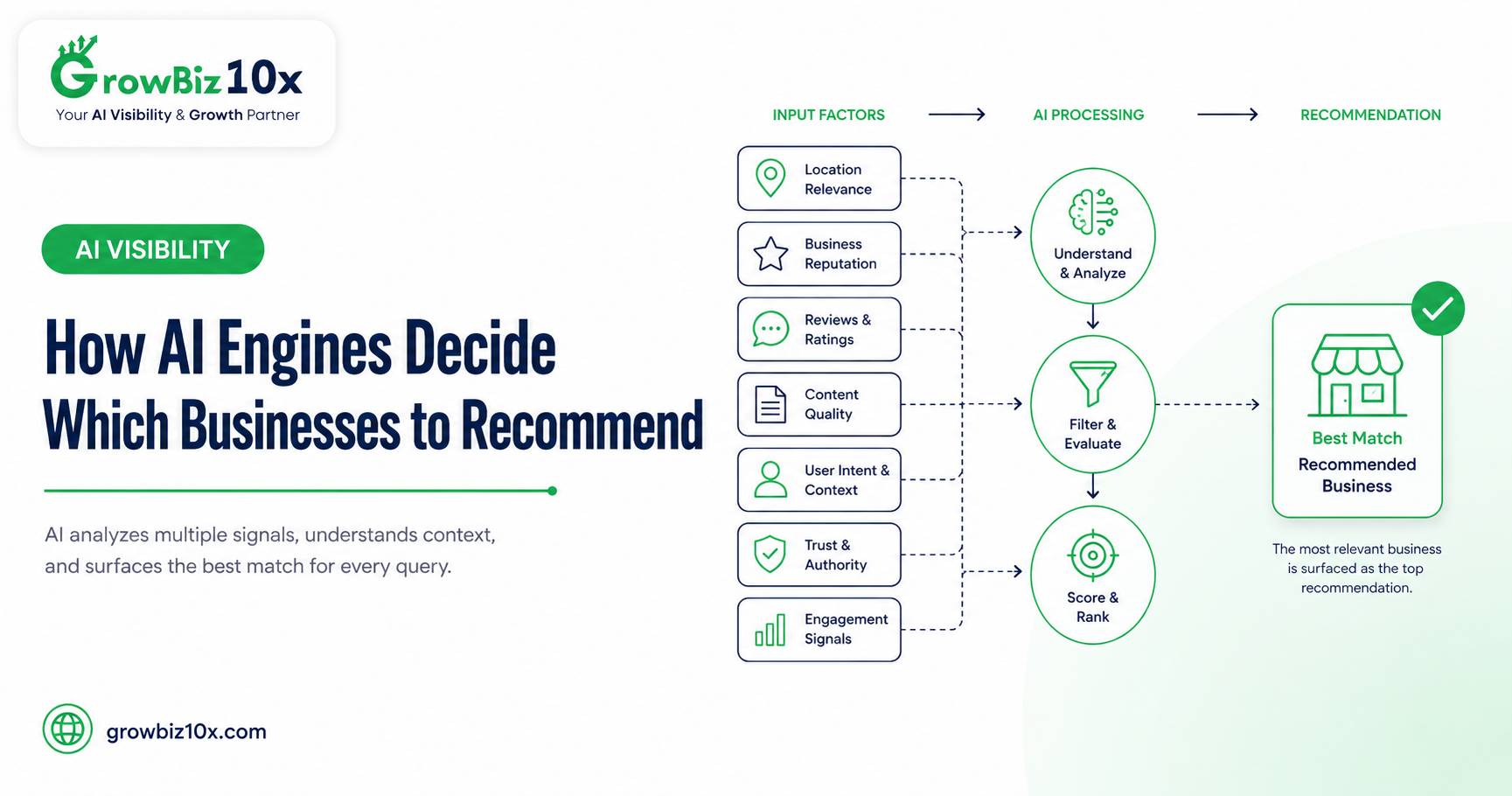
AI engines decide which businesses to recommend by blending two things: patterns learned during model training and fresh information retrieved from the web at the moment you ask. A business gets named when it appears consistently across sources the engine trusts, with clear signals about what it does, where it operates, and why it is credible. There is no single ranking algorithm to game. Instead, recommendations emerge from consensus across many independent signals, which is why AI visibility work looks different from traditional SEO.
Two Pathways: What the Model Knows and What It Looks Up
Large language models are trained on massive collections of web pages, articles, reviews, and reference material. During training, the model absorbs associations: this company is a plumbing service in Austin, that agency specializes in ecommerce email. When a user asks for a recommendation, the model can draw on those learned associations. Modern engines also use retrieval-augmented generation, meaning they run live searches, pull current pages into the model's context, and generate an answer grounded in what they just read. Most business recommendations today combine both pathways, so you need to be present in the training corpus and easy to retrieve right now. The two channels behave differently enough that we compare them side by side in Training Data vs Real-Time Retrieval: How AI Finds Business Information.
Entity Clarity Comes First
Before an AI engine can recommend you, it has to understand you as an entity: a distinct thing with a name, a category, a location, and relationships to other entities. If your business name, address, services, and descriptions vary across your website, Google Business Profile, directories, and social profiles, the model gets a fuzzy picture and defaults to competitors it understands better. Consistent naming, a clear one-line description used everywhere, and structured data markup on your site all help engines resolve your entity with confidence. This idea is unpacked fully in What Is an Entity and Why Does AI Care About Yours?.
Consensus Across Independent Sources
AI engines are cautious about claims that appear in only one place. A statement on your own website is a start, but the same facts echoed by review platforms, industry directories, local media, and community discussions carry far more weight. Signals that build consensus include:
- Consistent business details across directories and profiles
- Reviews on the platforms relevant to your industry, not just one site
- Mentions in local press, trade publications, and roundup articles
- Community discussions on forums such as Reddit that name your business
- Third-party pages that describe your services the same way you do
How Answers Get Assembled and Cited
When a retrieval-based engine answers a recommendation question, it typically searches, selects a handful of pages it considers authoritative, and synthesizes them into a response. Businesses named in those selected pages are the ones that get recommended, and the pages themselves become citations. This is why appearing in best-of lists, comparison articles, and well-regarded directories is so valuable: those are exactly the pages engines pull when someone asks who to hire. Your own site rarely gets to make the case alone.
A Worked Example: Two Firms, One Recommendation
Picture two residential electricians in the same city, Volt Bros and Current Solutions, with similar skills, pricing, and customer satisfaction. A homeowner asks an AI engine who should rewire a 1950s house, and the engine names Current Solutions. Look under the hood and the reasons are unglamorous. Current Solutions uses one exact name and one description across its website, Google Business Profile, and three directories. A local news piece on trusted tradespeople mentions it. Its reviews name specific jobs: panel upgrades, knob and tube replacement, EV charger installs. Its service pages answer common rewiring questions in the first paragraph. Volt Bros does equally good work, but it appears under three name variants, one of its profiles has been dormant for two years, its reviews say great job without detail, and its website leads with a slogan instead of an answer.
No single factor decided the outcome. The engine resolved one entity cleanly, found it corroborated across independent sources, and retrieved pages where it was named in context. Every one of those differences is a controllable input, which is exactly why this process rewards deliberate, patient work.
What Happens Between the Question and the Answer
It helps to walk through a recommendation query step by step. The details vary by engine, but the shape of the process is consistent:
- The engine interprets the question, extracting the intent, category, location, and any constraints such as budget or urgency
- If retrieval is enabled, it runs searches against a live index and gathers candidate pages
- It filters candidates for relevance and trustworthiness, favoring structured, answer-shaped sources
- The model reads the selected pages alongside what it already learned during training
- It resolves the entities involved, matching business mentions across sources into distinct candidates
- It drafts the answer, favoring businesses corroborated by more than one selected source
- Citations are attached where the response is grounded in specific retrieved pages
Businesses fall out of the running at specific stages. If your pages are not indexed or are blocked from crawlers, you never enter the candidate pool. If your entity is ambiguous, you get dropped during resolution. If only your own website vouches for you, you may survive to the final stage and still be omitted, because engines prefer corroborated names. Diagnosing which stage loses you is the fastest way to know what to fix first.
Definitions: The Terms Behind the Process
A few adjacent terms come up constantly in this space, and knowing them precisely makes the rest of the work clearer.
- Entity resolution: matching mentions of a business across different sources to one distinct identity
- Retrieval-augmented generation (RAG): searching for current documents and feeding them into the model's context before it answers
- Grounding: tying generated claims to retrieved sources so the answer reflects evidence rather than memory alone
- Citation: a source link an engine attaches to its answer, identifying the page that supported a claim
- Knowledge graph: a structured database of entities and relationships that engines use to verify and disambiguate facts
- Answer engine optimization (AEO): shaping content so it can be selected and quoted as a direct answer
- Generative engine optimization (GEO): the broader practice of improving how generative AI systems represent and recommend a business
Common Mistakes That Keep Businesses Out of AI Answers
Most AI visibility failures trace back to a short list of avoidable mistakes:
- Treating AI visibility as ordinary SEO and stopping once rankings look good
- Using different names, categories, or descriptions across profiles and listings
- Spreading effort across hundreds of weak directories instead of the few sources engines actually cite
- Letting reviews go stale or generic instead of steady and specific
- Publishing content about yourself rather than answers to buyer questions
- Blocking AI crawlers without weighing the lost visibility against the protected content
- Never actually asking the engines what they say about your business
None of these is fatal on its own, but they compound. An inconsistent entity makes weak corroboration weaker, and self-focused content makes retrieval misses more likely. Fixing them in order, entity first, is what turns scattered effort into visible progress.
Objections, Answered
This AI stuff is overhyped; my customers still use Google. Some do, and the overlap is the point: the work that wins AI recommendations, consistent data, real reviews, and useful content, is the same work that wins traditional local search. Investing in it pays off across both channels, whichever grows faster in your market.
We already rank first on Google, so we are covered. Ranking gets you into the candidate pool for retrieval, but the model decides which businesses to name. Pages that rank well yet lack corroboration or clarity are passed over regularly. Ranking and being recommended are related, but they are not the same achievement.
AI answers cannot be measured, so this is unmanageable. You can measure more than you might expect. Ask the major engines your buyers' questions on a schedule, record who gets named and which sources are cited, and track the trend over time. That is a measurable marketing input like any other.
Models make mistakes, so why invest in influencing them. Errors are exactly the argument for the work. Engines make fewer mistakes about businesses with consistent, corroborated public data, and retrieval-grounded answers improve as the underlying sources improve. Absence, not error, is the bigger commercial risk.
How the Pieces Fit Together
Each signal in this article reinforces the others. A clear entity makes every mention attributable to you, consistent listings corroborate the facts your website states, and structured data lets machines read those facts without guessing. Reviews then supply both quality evidence and the descriptive language engines repeat, a mechanism explored in The Role of Reviews and Reputation in AI Recommendations. Finally, mentions across the web teach models who you are during training, while presence on frequently cited pages wins the answer at retrieval time; How Citations and Brand Mentions Shape AI Answers breaks down that split.
The practical order matters. Entity clarity comes first, because every other signal attaches to it. Corroboration comes second, because engines trust agreement among independent sources. Answer-shaped content and citation placement come third, because they convert understanding into recommendations. Skipping ahead rarely works: a business pitching best-of lists while its listings disagree about its own name is pouring signal into a leaky foundation.
What This Means for Your Strategy
- Define your entity precisely and repeat it everywhere your business appears
- Earn reviews steadily on the platforms your industry actually uses
- Pursue mentions in the list and comparison content engines love to cite
- Publish specific, answerable content that states clearly who you serve and what you do
- Monitor AI answers in your category so you know where you stand
Frequently Asked Questions
Do AI engines use the same rankings as Google?
Not exactly. Engines that retrieve live results often start from a search index, so strong SEO helps you get into the candidate pool. But the model then decides which sources to trust and which businesses to name, so a page that ranks well can still be ignored if it lacks clarity or corroboration.
Can I pay to be recommended by AI engines?
No mainstream AI engine currently sells placement inside organic answers. Advertising products exist around some AI experiences, but the recommendation itself is generated from learned knowledge and retrieved sources. The reliable path is building the signals engines already trust.
How long does it take to influence AI recommendations?
Retrieval-driven answers can shift within weeks as new pages, reviews, and mentions appear, because engines read the live web. Knowledge baked into model training updates more slowly, arriving with new model versions. Treat AI visibility as a compounding effort rather than a quick fix.
Do different AI engines recommend different businesses?
Often, yes. Engines differ in training data, retrieval partners, and how aggressively they ground answers, so the same question can produce different names in ChatGPT, Perplexity, and Gemini. The overlap grows for businesses with strong, consistent signals, which is why fundamentals matter more than engine-specific tricks.
Can a brand-new business get recommended by AI?
Yes, mainly through the retrieval pathway. A new business is absent from training data for a while, but complete profiles, early reviews, local coverage, and answer-shaped pages can put it inside the sources engines cite within months. Training-data presence then builds over time as public mentions accumulate.
What should I do first if AI engines never mention my business?
Run a quick audit. Ask each major engine for recommendations in your category, then ask about your business by name. If the engines misdescribe you, fix entity consistency first. If they describe you accurately but never recommend you, focus on corroboration: reviews, earned mentions, and presence on the pages being cited.
Related reading
- What Sources Do AI Engines Trust When Recommending Businesses?
- How Large Language Models Learn About Your Business
- How Knowledge Graphs Influence AI Recommendations
- Why AI Recommends Your Competitors Instead of You
- Do Directories and Wikipedia Still Matter for AI Visibility?
- Why Google Rankings Don't Guarantee AI Visibility
Start Showing Up in AI Answers
AI engines reward businesses that are clearly defined, widely corroborated, and easy to retrieve. None of that happens by accident, but all of it can be built deliberately. GrowBiz10x shows you exactly how AI engines see your business today, tracks whether you are being recommended, and gives you a prioritized plan to change the answer. Get your AI visibility score at growbiz10x.com and find out what the engines are saying about you.
Want to see how your business performs across AI platforms?
Get a free AI visibility audit and personalized insights for your brand.
About the Author
GrowBiz10x Team
AEO SpecialistWe share actionable insights on AI visibility, content strategy, and digital growth to help businesses get discovered and grow faster.
Related Posts

Categories
- Commercial / Agency / GrowBiz10x20
- Industry-Specific10
- Measuring AI Visibility10
- Practical AEO/GEO10
- SEO vs AEO vs GEO10
- Brand Signals & Authority10
- How AI Understands & Recommends Businesses10
- The Search Shift10
- Pillar: AI Visibility10
Get the latest insights in your inbox.
Subscribe to our newsletter and never miss an update.