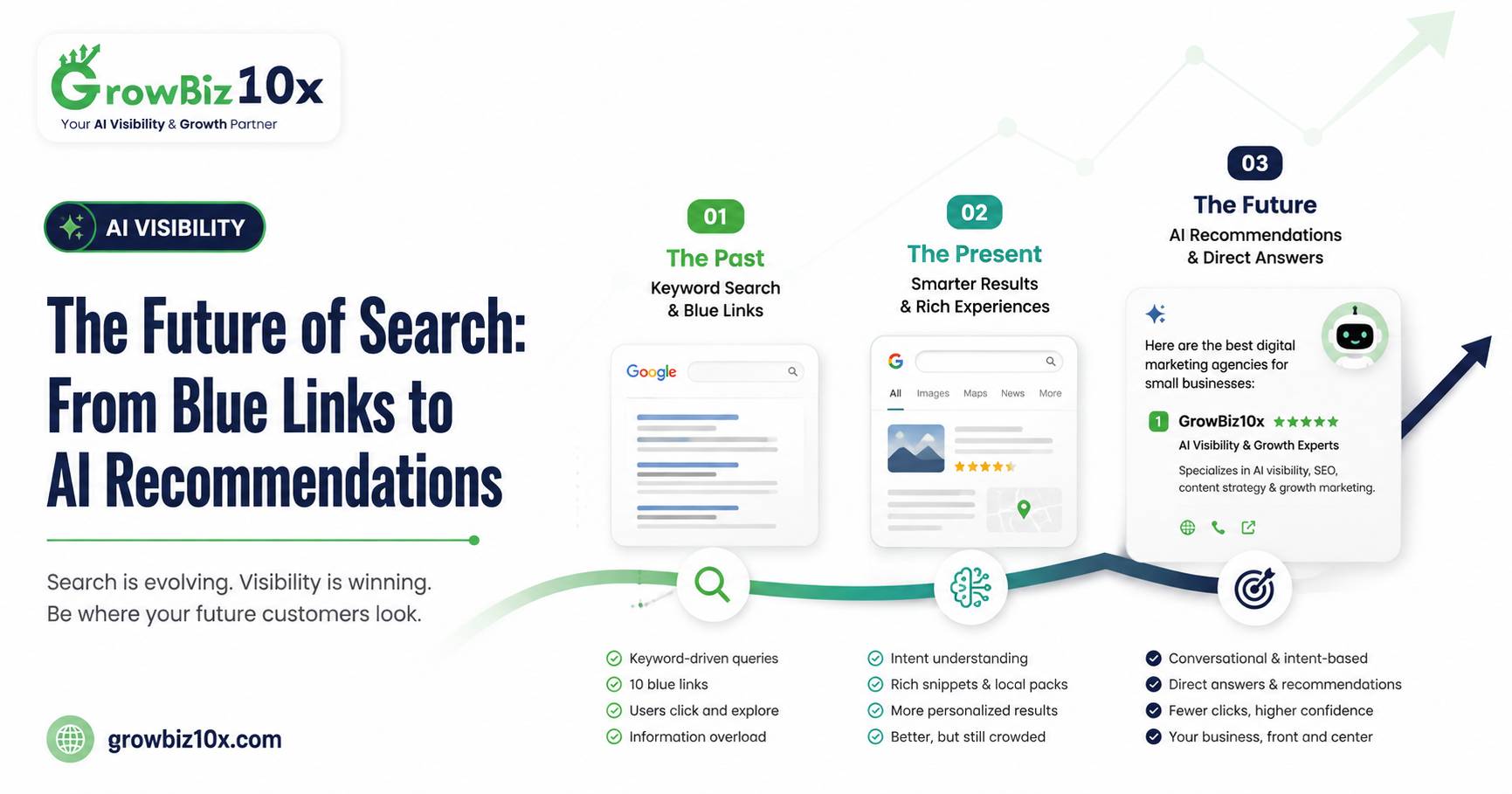
The future of search is a shift from pages of ranked blue links to direct AI recommendations delivered in conversation. Instead of presenting options for humans to evaluate, search systems increasingly evaluate the options themselves and present conclusions. For businesses, the defining question is changing from where do we rank to does the AI recommend us, and the time to prepare is before the transition finishes, not after.
A Short History of Finding Things
Discovery has reinvented itself roughly once a decade. Directories gave way to crawler-based search; ten blue links gave way to results pages enriched with maps, snippets, and ads; mobile and voice bent queries toward natural language. Each shift rewarded early adapters and punished businesses that kept optimizing for the previous era. AI answers are the next turn of the same wheel, and the pattern of winners and losers is already familiar.
From Presenting Options to Making Recommendations
The deep change is not the interface but the locus of judgment. Blue links left evaluation to the user; answer engines perform the evaluation and hand over a conclusion. A recommendation carries more weight than a ranking because it arrives as advice, phrased with reasons, from a tool the user trusts. That concentrates influence in fewer mentions: being one of three recommended names is worth far more than being one of twenty results, and being absent costs correspondingly more.
Terms Worth Knowing in the New Search Era
The vocabulary around AI search settles more slowly than the technology does. A few working definitions keep the rest of this guide, and the conversations you will have about it, precise:
- AI visibility: how often and how favorably AI systems mention, cite, or recommend your business when users ask relevant questions
- Answer engine: a system such as ChatGPT, Claude, Perplexity, Gemini, or Google AI Overviews that responds with a synthesized answer instead of a list of results
- AEO (answer engine optimization): the practice of making your business easy for answer engines to quote, cite, and recommend
- GEO (generative engine optimization): a closely related discipline focused on influencing generative AI outputs, often used interchangeably with AEO
- Zero-click search: a query resolved entirely inside the answer, with no visit to any website
- Citation: a source reference inside an AI answer, and one of the clearest signs an engine trusts your content
Keep these straight and strategy discussions get much simpler: AI visibility is the outcome you want, answer engines are where it happens, and AEO and GEO are how you pursue it.
Where Search Is Heading Next
Nobody can predict the details, but the trajectory is visible in what the platforms are building:
- Answers woven into every surface, from search results to browsers, phones, and cars
- Persistent context, where assistants remember preferences and personalize recommendations
- Agentic search, where AI not only recommends but books, orders, and purchases on the user's behalf
- Multimodal discovery, where photos and voice start business searches as often as text
Each step moves the customer decision further inside the AI layer and further from the traditional results page.
A Worked Example: One Customer, Three Eras of Search
To see how far discovery has moved, follow one buyer, a small business owner looking for a financial advisor, through three versions of the same task.
In the blue-link era, she searches financial advisor for small business owners, scans two pages of results, opens six websites, reads three blog posts, checks review sites separately, and emails two firms after several evenings of work. Every advisor with a decent page had a chance to be seen, because she did all of the evaluating herself.
In the enriched-results era, the work shrinks but stays manual. A map pack and star ratings frame her choices, featured snippets answer her side questions, and she visits perhaps four sites before shortlisting two. Ranking position now decides who gets seen at all, and the businesses below the fold quietly drop out of contention.
In the AI era, she describes her situation in one message: her revenue range, her goals, her preference for flat fees. The assistant names three advisory firms, explains why each fits, answers her follow-up questions about credentials and typical costs, and drafts an inquiry email. She visits one website, the finalist's, to verify what she has been told. The firms mentioned were the ones whose information the engine could find, parse, and trust; the rest were never in the running. Notice what changed: not her need, but who performed the evaluation and how many businesses got a chance to compete for it.
What Stays Valuable Through the Transition
Amid the change, durable assets keep their worth. Real expertise and a differentiated offer give AI something worth recommending. Reputation, expressed in reviews and mentions, remains the currency of trust. Clear, structured, honest information travels well into any engine. And a recognizable brand lets customers ask for you by name, the one query no competitor can intercept. Businesses strong on these fundamentals will survive interface shifts that wipe out purely tactical advantages.
How to Prepare Your Business Now
Preparation is practical, not speculative. Establish your baseline by asking the major assistants the questions your customers ask and recording where you stand. Fix the foundations: consistent business data, quotable service pages, schema markup, active review generation. Earn corroboration through directories, press, and industry mentions. Then instrument the channel: monitor mentions and citations over time the way you once monitored rankings, and treat regressions as urgent. Early movers are compounding an advantage while most competitors are still debating whether the shift is real.
A Step-by-Step Plan for the Next 90 Days
If the preparation list above feels abstract, here is the same work as a concrete sequence a small team can execute:
- Week 1: Run your baseline. Ask ChatGPT, Gemini, and Perplexity ten questions your customers would ask, and record every mention, absence, and error.
- Weeks 2 and 3: Fix your facts. Align your name, address, services, and descriptions across your website, Google Business Profile, and every directory that lists you.
- Weeks 4 to 6: Make key pages quotable. Rewrite your top service pages so each opens with a direct, self-contained answer to the question it serves.
- Weeks 7 and 8: Add structure. Implement schema markup for your organization, services, locations, and FAQs so machines can parse your facts without guessing.
- Weeks 9 to 11: Build corroboration. Pursue reviews steadily and earn two or three third-party mentions in directories, local press, or industry publications.
- Week 12: Re-run the baseline. Compare answers against week one, log what moved, and set the next quarter's priorities from the gaps that remain.
None of these steps requires new technology or a large budget. They require consistency, which is exactly what most competitors will not sustain.
Common Objections, Answered
Our customers do not use AI. Some do not, yet. But adoption is spreading through every demographic, and the sources AI engines rely on, reviews, listings, structured content, take months to build. The right time to construct visibility is before your customers arrive on the channel, not after your competitors have become the default answer.
We already rank first on Google. Rankings are worth keeping, but they are a different contest. Answer engines weigh consistency, corroboration, and quotability, and a top-ranked site can still be absent from AI answers if those signals are weak. Treat your ranking as a head start, not a guarantee.
We would rather wait until the space settles. Waiting feels safe but carries a quiet cost: engines are forming durable impressions of your category right now, and early mentions compound. The businesses named today are accumulating the reviews, citations, and reputation that make them easier to name tomorrow. Catching up later means doing the same work against an entrenched incumbent.
Common Mistakes to Avoid
Most early failures in AI search are self-inflicted. Watch for these patterns:
- Treating AI visibility as a one-time project instead of an ongoing practice of testing, fixing, and re-testing
- Chasing tricks aimed at manipulating models rather than fixing the information those models actually read
- Leaving contradictory business details scattered across old listings, which teaches engines to distrust everything else about you
- Writing pages for keyword density instead of direct answers, leaving nothing an engine can cleanly quote
- Measuring only rankings and traffic while ignoring mentions, citations, and how AI describes your business
How the Pieces of the Search Shift Fit Together
This article is the map; the rest of this series explores each territory. The shift begins with behavior: how people are using ChatGPT instead of Google to find businesses shows the habit forming, and how customers search for products and services using AI breaks down the conversational patterns that replace keywords.
From there, the mechanics matter. What happens when a customer asks AI for a business recommendation walks through the pipeline that turns a question into a shortlist, and why customers may visit fewer websites before making a decision follows the consequences into your traffic and funnel.
Read together, they tell one story: discovery is moving into the answer layer, the answer layer runs on trust signals you can influence, and the work of influencing them is ordinary, disciplined marketing aimed at a new reader.
Frequently Asked Questions
Will blue links disappear completely?
Unlikely any time soon. Links persist inside AI answers as citations, and many tasks still send users to websites. What is fading is the results page as the primary decision surface; evaluation is moving into the answer layer above it.
When should my business start optimizing for AI search?
Now. AI visibility compounds slowly, through accumulated consistency, reviews, and mentions, and early presence tends to persist in both training data and retrieval sources. Waiting for the shift to complete means starting from behind.
What is the single best first step?
Run the test your customers run: ask ChatGPT, Gemini, and Perplexity for recommendations in your category and location. Whatever those answers reveal, whether missing information, wrong details, or total absence, becomes your first work item.
How is an AI recommendation different from a high Google ranking?
A ranking is a position on a list the user still has to evaluate; a recommendation is a conclusion delivered with reasons. Rankings reward relevance and authority signals a crawler can score. Recommendations add a layer of judgment: consistency, reputation, and quotability across many sources. A business can hold one without the other, which is why both need measuring.
Do I need new tools to compete in AI-driven search?
You can start with nothing but the assistants themselves: ask them your customers' questions and log the answers. As the work scales, dedicated AI visibility monitoring saves time and catches changes you would miss manually. The tooling helps, but the fundamentals, consistent data, quotable content, and real reputation, do the winning.
Related reading
- How AI Is Changing Local Business Discovery
- How AI Search Is Changing the Buyer's Journey
- AI Search vs Google Search: How Customer Behavior Is Different
- What Are Zero-Click AI Searches and Why Do They Matter?
- How Conversational Search Is Changing SEO
Build for the Search That Is Coming
The move from blue links to AI recommendations is the biggest change in discovery in a generation, and it is happening while most businesses are looking elsewhere. GrowBiz10x gives you the visibility scoreboard for the AI era: where you are mentioned, how you are described, and exactly what to improve next. Claim your free AI visibility report at growbiz10x.com and step into the future of search ahead of your competitors.
Want to see how your business performs across AI platforms?
Get a free AI visibility audit and personalized insights for your brand.
About the Author
GrowBiz10x Team
AEO SpecialistWe share actionable insights on AI visibility, content strategy, and digital growth to help businesses get discovered and grow faster.
Related Posts

Categories
- Commercial / Agency / GrowBiz10x20
- Industry-Specific10
- Measuring AI Visibility10
- Practical AEO/GEO10
- SEO vs AEO vs GEO10
- Brand Signals & Authority10
- How AI Understands & Recommends Businesses10
- The Search Shift10
- Pillar: AI Visibility10
Get the latest insights in your inbox.
Subscribe to our newsletter and never miss an update.