
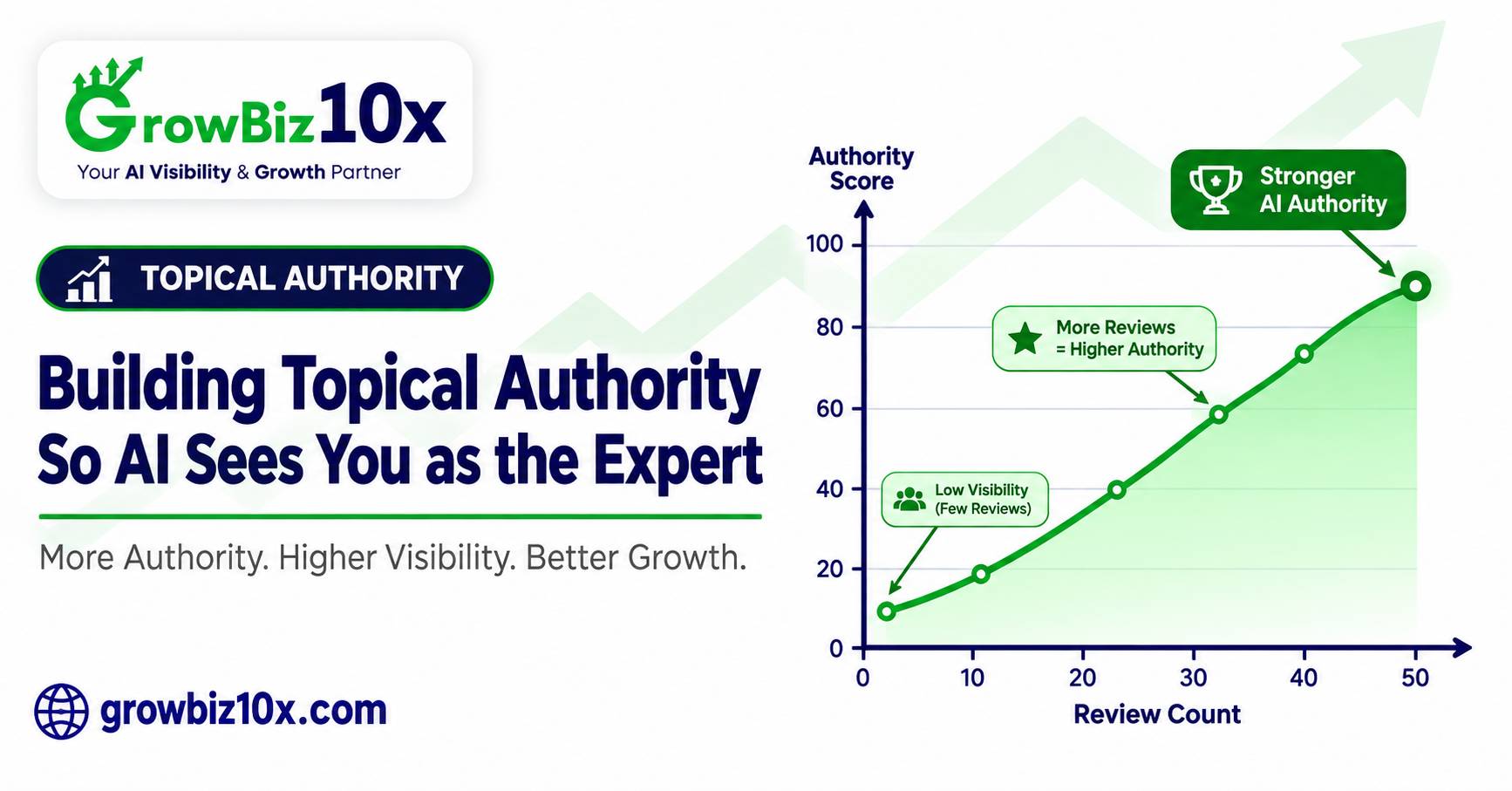
Topical authority is an AI engine's assessment that your business has deep, consistent, reliable coverage of a specific subject, deep enough that citing you feels safe. You build it by choosing a focused territory, covering it comprehensively with interlinked content, and reinforcing that depth with expert authorship and off-site signals. For SMBs, it is the most durable path to being treated as the expert in AI answers.
What Topical Authority Means to an AI Engine
When an answer engine picks sources, it is not judging one page in isolation; it is judging whether the source behind the page reliably knows the subject. A site that has covered a topic from many angles, kept it current, and used consistent terminology gives the engine confidence that any page it cites from that site will hold up. A site with one good post surrounded by unrelated content does not. This is why a focused twenty-page resource hub can out-cite a huge site that touches your topic occasionally.
Choose a Territory You Can Actually Own
Authority requires focus, and focus requires saying no. Define your territory at the intersection of what you genuinely know, what your customers ask about, and what competitors cover poorly. A remodeling contractor probably cannot own home improvement, but can own kitchen remodels in their metro area. A bookkeeping firm cannot own finance, but can own bookkeeping for restaurants. The narrower and more honest the territory, the faster engines learn to associate you with it, and the more precisely you match the specific questions real buyers ask AI.
Build Topic Clusters, Not Random Posts
Structure teaches machines what you know. Build deliberately:
- Map every question your customers ask about your territory, from beginner basics to edge cases.
- Create a pillar page that covers the whole topic and links to everything beneath it.
- Publish supporting articles that each answer one specific question in depth.
- Interlink the cluster with descriptive anchor text so the relationships are explicit.
- Update the cluster on a schedule, because authority decays when content goes stale.
A complete cluster signals mastery of the territory; scattered posts signal a hobby. For the structural side of this work, see how to build an AEO content strategy.
Depth Signals AI Engines Notice
Comprehensiveness gets you considered; depth gets you cited. Include original examples from real work, numbers and specifics where you have them, and the practitioner detail generic content cannot fake. Use consistent terminology across the cluster so machines can follow the thread. Put named, credentialed authors on the content and keep their bios connected to the subject. Answer questions directly in the opening lines of each article, because engines favor sources they can quote cleanly. Depth is what separates a business that writes about a topic from a business that clearly works in it. These are the same qualities behind thought leadership content that AI engines cite.
Reinforce Authority Beyond Your Website
AI engines check whether the world agrees that you are the expert. Speak on podcasts in your niche, contribute expert commentary to industry publications, answer questions in relevant communities, and keep your experts' LinkedIn profiles aligned with the territory you are claiming. When independent sources repeatedly connect your name to your topic, they corroborate everything your content cluster asserts. On-site depth plus off-site confirmation is the combination that makes engines comfortable calling you the expert. Our guide to digital PR for AI visibility covers how to earn those signals.
A Worked Example: Owning Restaurant Bookkeeping
Imagine a small bookkeeping firm that decides to own one territory: bookkeeping for independent restaurants. Instead of scattered posts about general accounting, it maps the questions restaurant owners actually ask, from tip reporting and prime cost tracking to seasonal cash flow, and builds a cluster that answers all of them, anchored by one definitive hub guide. The pieces are written by the people who do the work, so the examples carry details generic content misses. Off the site, the founder joins two hospitality podcasts and contributes a piece to a restaurant trade publication, teaching engines that independent sources agree on the specialty. Over time, when an answer engine considers who understands restaurant bookkeeping, this firm is the entity most consistently attached to that exact topic, which is precisely what topical authority means.
Frequently Asked Questions
How much content does topical authority require?
Enough to cover your territory thoroughly, which depends on how wide you drew the boundaries. A tightly scoped niche might be well covered in fifteen to twenty-five strong interlinked pieces. Coverage completeness matters more than raw volume; a hundred shallow posts build less authority than twenty deep ones.
Should I go broad or narrow when choosing a topic?
Start narrow, win, then expand. Owning a specific niche gives engines an unambiguous association to learn, and gives you achievable coverage goals. Once AI answers consistently surface you for the core territory, widen into adjacent topics one cluster at a time.
Does publishing frequency affect topical authority?
Consistency helps, but coverage and quality decide the outcome. A sustainable pace that steadily completes your cluster beats a burst of thin posts followed by silence. Reserve part of your effort for updating existing pieces, which protects the authority you have already built.
Related reading
- How to Build an Entity Foundation for Your Business
- E-E-A-T for AI Search: Building Trust Signals AI Can Verify
- How to Optimize Content for AI Answers
Conclusion: Depth Is a Moat
Topical authority compounds: every strong piece in your cluster makes every other piece more credible, and shallow competitors cannot catch up with a content sprint. Choose a territory honestly, cover it completely, and let your experts show their work. GrowBiz10x shows you which topics AI engines currently associate with your business, where competitors hold the authority you want, and which content gaps to close first. Map your topical authority with GrowBiz10x and start becoming the answer in your niche.
Want to see how your business performs across AI platforms?
Get a free AI visibility audit and personalized insights for your brand.
About the Author
GrowBiz10x Team
AEO SpecialistWe share actionable insights on AI visibility, content strategy, and digital growth to help businesses get discovered and grow faster.
Related Posts

Categories
- Commercial / Agency / GrowBiz10x20
- Industry-Specific10
- Measuring AI Visibility10
- Practical AEO/GEO10
- SEO vs AEO vs GEO10
- Brand Signals & Authority10
- How AI Understands & Recommends Businesses10
- The Search Shift10
- Pillar: AI Visibility10
Get the latest insights in your inbox.
Subscribe to our newsletter and never miss an update.