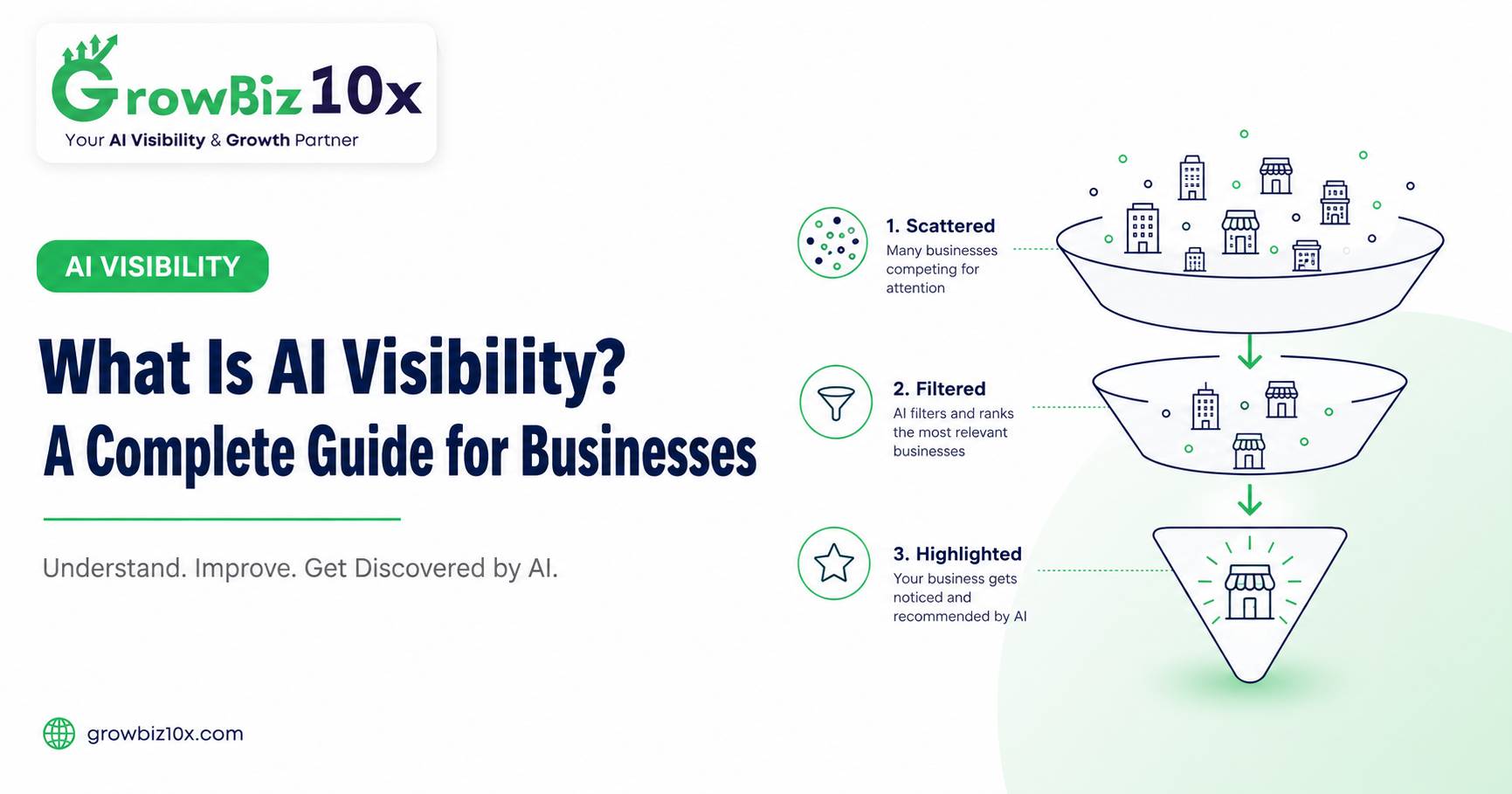
AI visibility is the measure of how often and how accurately your business appears in answers generated by AI tools such as ChatGPT, Claude, Perplexity, Gemini, and Google AI Overviews. If AI engines can find, understand, and trust your brand, they recommend it to buyers; if they cannot, you are effectively invisible to a growing share of your market. As people increasingly ask conversational AI for recommendations instead of scanning search results, traditional search engine optimization alone is no longer enough.
Understanding AI Visibility
AI visibility dictates whether your brand is extracted, understood, and recommended by large language models. Unlike standard search engines that rank pages based on backlinks and keyword density, AI engines construct answers by synthesizing information from authoritative, well-structured sources. Your goal is no longer just to rank on a results page. It is to become part of the answer itself, named by the AI when a customer asks for the best option in your category. The mechanics behind that choice are worth understanding in their own right, and we cover them in depth in How AI Engines Decide Which Businesses to Recommend.
A useful way to hold the idea is as three questions a machine asks about you. Can I find this business and its facts? Can I understand exactly what it offers, for whom, and where? Can I trust it enough to put my recommendation behind it? Every tactic in this guide strengthens the answer to one of those three questions, and weakness in any one of them can keep you out of the answer.
Core Components of AI Visibility
- Structured data (schema markup) - helps AI systems understand exactly what your business is, what it offers, and where it operates.
- Entity authority - consistent mentions of your brand across high-trust directories, review platforms, and industry publications.
- Conversational content - pages that directly answer the questions real customers ask, written in language an AI can quote.
- Third-party validation - reviews, citations, and coverage that confirm your claims from sources you do not control.
How AI Visibility Differs from Traditional SEO
Traditional SEO competes for a position on a results page, where even a lower ranking can still earn clicks. AI visibility competes for a place inside a single synthesized answer, which usually names only a handful of businesses. That makes the outcome closer to all or nothing: you are either part of the recommendation or absent from it. AI engines also weigh your presence across the entire web, not just your own site, so consistency and reputation matter as much as on-page optimization.
Adjacent Terms Worth Knowing
AI visibility sits inside a family of related terms, and knowing them makes the rest of this guide easier to follow. Answer engine optimization, or AEO, is the practice of structuring content so AI assistants can quote it when they answer questions. Generative engine optimization, or GEO, is the broader discipline of influencing how generative AI systems describe and recommend brands. An entity is the machine's concept of your business: a named thing with attributes such as services, locations, credentials, and reputation. A citation is when an AI answer references your website or a page about you as a source, while a mention is when your brand is named inside the answer itself.
You do not need to master every acronym before making progress. The disciplines overlap heavily, and the work described in this guide serves all of them at once. If you want a clean comparison of the terminology and where each practice focuses, AEO vs SEO: What Is the Difference? breaks it down.
Why It Matters Now
By ignoring AI visibility, your business risks becoming invisible to a large segment of digital consumers who prefer direct answers over scrolling through ten blue links.
A growing share of buyers now start their research by asking an assistant for a shortlist. When that happens, the businesses named in the answer capture the demand, and everyone else is skipped entirely. Acting early also compounds: once AI engines learn to associate your brand with a topic, they tend to keep drawing on the sources they already trust, which makes an established position easier to defend.
A Worked Example: Two Firms, One Question
Consider two family law firms in the same city. Firm A describes itself online as a trusted partner delivering excellence. Its address is formatted differently across three directories, its reviews are thin, and its service pages are generic. Firm B states plainly that it handles divorce, custody, and adoption cases in its county, keeps identical details everywhere it is listed, publishes a page answering each question clients actually ask, and has a steady flow of detailed reviews.
Now a potential client asks an assistant which family lawyer in the city handles contested custody cases and offers payment plans. The engine retrieves what it can verify. Firm B's custody page answers the exact question, its reviews corroborate the claim, and its consistent data lets the engine describe it confidently. Firm A gives the engine almost nothing to work with, so it is left out of the answer entirely. Notice that nothing about Firm A's actual competence was judged; only its evidence was. That is AI visibility in miniature: the best-documented business wins the recommendation, not necessarily the best-known one.
How to Start Improving Your AI Visibility
- Ask ChatGPT, Perplexity, and Gemini the questions your customers ask, and record whether and how your business appears.
- Fix inconsistencies in your name, description, services, and contact details across your website, profiles, and directories.
- Add schema markup so machines can read your key facts without guesswork.
- Publish answer-first content that resolves one clear customer question per page.
- Earn mentions and reviews on the third-party sources AI engines already trust in your industry.
Your First 30 Days, Step by Step
Here is how the five moves above translate into a realistic first month of work for a small team.
Week one: establish the baseline. Write down the ten questions that lead customers to businesses like yours. Ask them in ChatGPT, Perplexity, and Gemini, and save every answer. Then ask each assistant directly what it knows about your business. You now have a record of your starting point, a list of errors to correct, and the names of the competitors currently taking your recommendations.
Week two: clean up your identity. Choose one canonical business name, one clear description of what you do and for whom, and one set of contact details. Update your website, Google Business Profile, social profiles, and the directories that matter in your industry until every source agrees.
Weeks three and four: content and markup. Add organization and service schema to your site, then rewrite your most important page so it answers one high-value customer question directly in its first two sentences. Publish one new answer page for the question you most want to win, and set up a simple routine for requesting reviews from happy customers.
None of this requires new tools or budget approvals. It requires focus, and it produces exactly the kind of evidence AI engines can use the next time they read about you.
Common Mistakes That Keep Businesses Invisible
- Treating it as a one-time project. Models update and competitors improve, so visibility decays quietly without maintenance.
- Publishing vague marketing copy. Engines cannot quote a page that never states a plain, checkable fact.
- Ignoring third-party sources. Your own website is only one voice; engines weigh what others say about you just as heavily.
- Letting listings drift. Conflicting names, addresses, or descriptions make engines hesitant to recommend you at all.
- Measuring nothing. Without a baseline and regular re-testing, you cannot tell whether any of the work is moving the needle.
But Is This Really Worth the Effort?
Skepticism is fair, so it is worth answering the common doubts directly. If you think your customers do not use AI tools, remember that AI answers now appear inside ordinary Google results through AI Overviews, so your buyers see machine-generated recommendations even when they never open a chatbot. If you worry that the field changes too fast to invest in, notice what stays stable: engines will always need accurate data, quotable content, and credible third parties vouching for you, and those assets keep their value no matter which assistant wins market share. And if you believe strong SEO already covers you, the overlap is real but incomplete. Rankings do not guarantee that you are named inside generated answers, and being absent from those answers never shows up in your analytics, which is precisely what makes it dangerous.
How the Pieces Fit Together
This guide defines the landscape, and the posts around it go deeper on each part. Start with What Is AI Search and How Does It Work? to understand the machinery that generates the answers. From there, the work divides into three layers: understanding how engines evaluate you, making the fixes that improve your standing, and monitoring the results month after month.
When you are ready to execute end to end, The Ultimate Guide to AI Visibility: What Businesses Need to Know in 2026 is the companion playbook to this guide. It turns the definitions you have just read into a sequenced plan with steps, milestones, and measures.
Frequently Asked Questions
Is AI visibility the same as SEO?
No. SEO helps you rank in traditional search results, while AI visibility determines whether AI assistants mention and recommend you inside generated answers. The two overlap, and strong SEO helps, but AI visibility also depends on entity clarity, structured data, and third-party trust signals that classic rankings do not fully capture.
Which AI platforms should businesses focus on?
Start with the platforms your customers actually use: ChatGPT, Google AI Overviews and Gemini, Perplexity, and Claude cover most early AI research behavior. Because they draw on overlapping public sources, improving your core presence with consistent data, quotable content, and credible reviews tends to lift visibility across all of them at once.
How long does it take to improve AI visibility?
Many businesses see AI descriptions of their brand improve within a few months of cleaning up their data and publishing answer-focused content, though timelines vary by industry and competition. Treat it like reputation building: steady, consistent signals outperform short bursts of activity.
How much does AI visibility cost to improve?
The core work is labor rather than licensing: cleaning up listings, writing answer-focused pages, and requesting reviews are tasks most teams can absorb. Costs rise mainly when you add dedicated monitoring tools or outside help for content and outreach. Starting small is legitimate, because consistency matters more than budget.
Can AI visibility be outsourced?
Partially. Agencies and platforms can run audits, monitor answers, and produce content, but the raw material has to come from you: accurate business facts, real credentials, and genuine customer relationships that generate reviews. The businesses that do best treat outsourcing as acceleration, not substitution.
Related reading
- How AI Search Is Changing the Way Customers Find Businesses
- What Does AI Visibility Mean for Your Business?
- How AI Determines Whether a Business Is Relevant
- How to Measure AI Visibility for Your Business
Take Control of How AI Sees Your Business
AI visibility is quickly becoming a foundation of business growth, deciding which brands get recommended and which get overlooked. The businesses that invest now will own the answers their competitors are missing from. GrowBiz10x shows you exactly how AI engines describe your business today and gives you a clear plan to improve it. Run an AI visibility audit with GrowBiz10x and find out how your business shows up in AI answers.
Want to see how your business performs across AI platforms?
Get a free AI visibility audit and personalized insights for your brand.
About the Author
GrowBiz10x Team
AEO SpecialistWe share actionable insights on AI visibility, content strategy, and digital growth to help businesses get discovered and grow faster.
Related Posts

Categories
- Commercial / Agency / GrowBiz10x20
- Industry-Specific10
- Measuring AI Visibility10
- Practical AEO/GEO10
- SEO vs AEO vs GEO10
- Brand Signals & Authority10
- How AI Understands & Recommends Businesses10
- The Search Shift10
- Pillar: AI Visibility10
Get the latest insights in your inbox.
Subscribe to our newsletter and never miss an update.