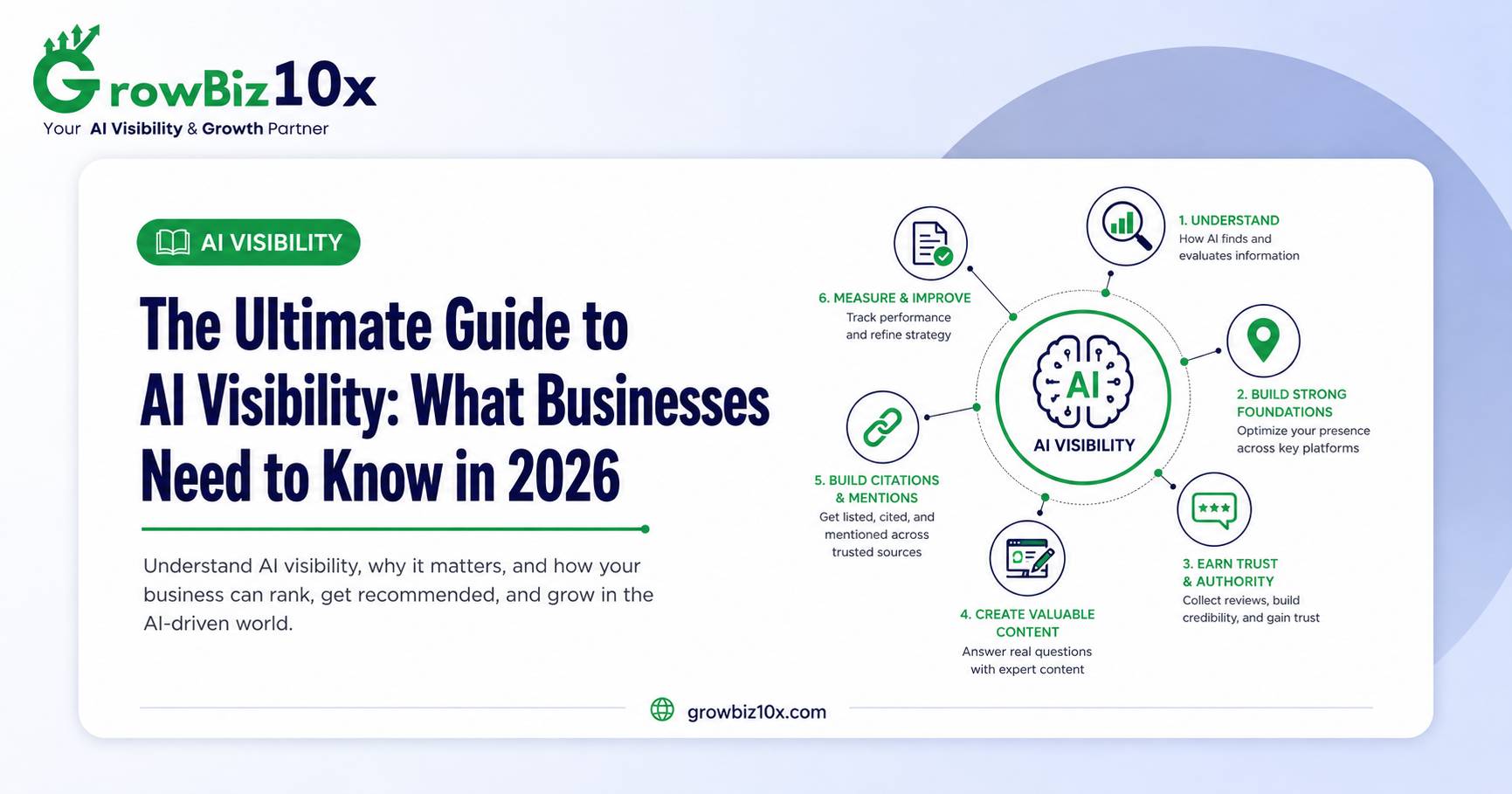
AI visibility is how findable, understandable, and recommendable your business is to AI answer engines such as ChatGPT, Claude, Perplexity, Gemini, and Google AI Overviews. In 2026 it has moved from a curiosity to a core growth channel: a meaningful share of customers now discover, compare, and choose businesses inside AI conversations, and the businesses that get named in those answers capture demand the rest never see. This guide pulls together the fundamentals: how AI search works, how engines choose whom to recommend, and how to build a strategy that earns you a place in the answers.
Why AI Visibility Matters in 2026
Discovery has changed shape. Instead of scanning ranked links, customers ask conversational questions and receive synthesized answers naming a few options. Those shortlists compress the funnel: awareness, comparison, and selection can happen in a single response, often without a website visit. The consequence is stark. In traditional search, ranking fifth still earned traffic; in an AI answer, there is no fifth position. Being included is the new page one, and businesses that ignore this shift are not losing rankings, they are losing presence in the conversation entirely. If you want the full definitional grounding before the playbook, What Is AI Visibility? A Complete Guide for Businesses covers what the term means and why it works the way it does; this guide focuses on execution.
How AI Search Works in Plain English
Most AI search runs on retrieval augmented generation. The engine interprets the intent behind a question, retrieves relevant, current information from web pages, listings, reviews, and other sources, and then generates a natural-language answer, often citing what it used. Two things follow from this design. First, your visibility depends on your entire web footprint, because engines read far beyond your homepage. Second, you have ongoing influence: engines re-read the live web, so improvements you make today shape the answers they generate tomorrow.
Key Terms in Plain Language
- AEO (answer engine optimization): structuring content so assistants can lift and quote it when they answer questions.
- GEO (generative engine optimization): the broader practice of influencing how generative AI systems describe and recommend brands.
- Entity: the machine's record of your business as a named thing with attributes, evidence, and a reputation.
- Mention: your brand named inside an AI answer.
- Citation: your website or a page about you referenced as a source for an answer.
How AI Engines Decide Which Businesses to Recommend
Engines evaluate businesses as entities: named things with attributes, evidence, and reputations. When a question arrives, they match its specific intent against that evidence. Relevance is judged per question, which is why a specialist with deep, specific content can beat a household name for the queries that matter to it. Consistency is decisive: when independent sources agree about who you are and what you do, engines recommend you confidently; when sources conflict, the safe move for the machine is to leave you out. Third-party validation, especially reviews and mentions in trusted sources, separates claims from facts.
A Scenario Walkthrough: How One Recommendation Happens
Picture a buyer asking an assistant to recommend a bookkeeping service for a small ecommerce brand that sells in two countries. The engine breaks the question into requirements: bookkeeping, small business, ecommerce experience, multi-country tax exposure. It then retrieves candidates and checks each one's evidence. A firm whose site promises full-service accounting solutions gives the engine nothing to match against the ecommerce requirement. A firm with a page describing bookkeeping for ecommerce sellers, a client story about cross-border sales tax, and reviews that mention online stores matches every requirement in the question.
The answer names the second firm and summarizes why. The buyer never sees the process, only the conclusion. Every step of the playbook below exists to make sure that when this invisible evaluation runs in your category, your business is the one whose evidence lines up.
The Four Pillars of AI Visibility
- Entity clarity: one consistent name, description, and set of facts everywhere your business appears, backed by schema markup.
- Quotable content: answer-first pages that resolve one real customer question each, in specific, plain language.
- Earned authority: genuine reviews, credentials, and mentions from third-party sources engines trust.
- Continuous monitoring: regular testing of how AI assistants describe and recommend you, so you catch drift and measure progress.
Building Your AI Visibility Strategy Step by Step
- Set concrete goals: the questions you want to be named for and the platforms that matter to your market.
- Audit your baseline by asking major assistants your target questions and recording who appears and how you are described.
- Map the real questions your customers ask, from early research to final comparison.
- Fix your entity foundations: consistent data everywhere, plus structured markup.
- Publish focused answer pages for your priority questions, and back claims with proof.
- Build reviews and third-party mentions on the sources your industry trusts.
- Re-test monthly, compare against your baseline, and reallocate effort to what moves.
The Playbook in Detail: From Baseline to Momentum
Days 1 to 30: Establish the Baseline and Fix Identity
Run a structured baseline: a fixed list of customer questions, asked across ChatGPT, Perplexity, Gemini, and Google AI Overviews, with every answer logged. Follow the process in How to Run an AI Visibility Audit if you want a repeatable template. Then fix identity: one canonical name, description, and set of facts across your website, profiles, and directories, plus organization and service schema on your site. Identity work is front-loaded deliberately, because every later step builds on data the engines can trust.
Days 31 to 60: Publish Answer Pages and Gather Proof
Take your five highest-intent questions and give each one a focused page with the direct answer in the first two sentences, specifics in the body, and an FAQ block at the end. Improve the machine readability of your site as you go; How to Optimize Your Website for AI Search covers the structural work. In parallel, start a review cadence: every satisfied customer gets a simple, timely request, so independent proof accumulates alongside your content.
Days 61 to 90: Earn Authority and Re-Test
Pursue the third-party signals engines trust: industry directories, associations, local publications, and expert contributions in the places your customers ask questions. Then re-run the baseline and compare it to day one. Expect small wins first, such as corrected descriptions or a first mention on a niche question, and reallocate effort toward whatever moved. From here the playbook repeats as a quarterly rhythm rather than a project.
Common Mistakes, and What Comes Next
The most common failures are avoidable: treating AI visibility as a one-time project instead of an operated channel, publishing vague marketing copy that engines cannot quote, tolerating conflicting business details across the web, and ignoring reviews because they feel unglamorous. Avoiding these puts you ahead of most competitors. Looking forward, expect AI agents to take on more of the journey, researching, comparing, and even transacting on a customer's behalf, and expect answers to become more personalized. Both trends raise the value of the same fundamentals: structured data, verified reputation, and honest positioning that helps machines match you to the customers you serve best.
A few more traps deserve a place on the list:
- Chasing every platform at once instead of concentrating on the assistants your customers actually use.
- Optimizing only the homepage while the specific questions buyers ask go unanswered anywhere on your site.
- Manufacturing reviews or gaming signals, which engines increasingly cross-check and discount, putting hard-won trust at risk.
- Leaving the work unowned, so every task is someone else's job and the cadence collapses by the second month.
- Stopping after the first wins, handing your position to the next competitor willing to stay consistent.
Objection Handling: Why Businesses Wait, and Why They Should Not
We already rank well on Google. Rankings help, but they do not guarantee you are named inside generated answers. The overlap between the disciplines is real, and so is the gap: engines weigh entity clarity, corroboration, and reviews in ways rankings do not capture.
Our customers are not using AI yet. Some already are, invisibly, because AI Overviews sit inside ordinary Google results. You will not see the queries you were never surfaced for; absence leaves no trace in your analytics.
It is too early; the technology keeps changing. Interfaces change, but the inputs do not. Accurate data, quotable content, and earned authority have held their value through every platform shift so far, and they transfer to whatever surface comes next.
How the Pieces Fit Together
This guide is the end-to-end playbook, and the surrounding posts break out each stage in more detail. The strategy layer, covering goals, question maps, owners, and cadence, is expanded in How to Build an AI Visibility Strategy for Your Business. The execution and maintenance layers are covered by the improvement guide and checklist listed below. Work top down: set strategy once, execute weekly, and measure monthly, so each layer feeds the next.
Frequently Asked Questions
Is AI visibility replacing SEO?
No, it extends it. Traditional search still drives real business, and the disciplines overlap heavily: good structure, helpful content, and earned authority serve both. What changes is the goal, from ranking on a results page to being named inside generated answers, and that requires the added layers of entity consistency and quotable, answer-first content.
How do I measure AI visibility?
Track whether AI assistants mention you for a fixed set of customer questions, how accurately they describe you, and how you compare to competitors, then watch referral traffic and inquiries arriving from AI platforms. A consistent monthly test against a recorded baseline turns a fuzzy concept into a metric you can manage.
What should a business do first?
Run a baseline audit. Ask the major assistants the questions your customers ask, record the results, and ask what they know about your business. The gaps and errors you find dictate everything else: what to fix, what to publish, and what to measure. Strategy built on that evidence beats guesswork every time.
Do I need a dedicated platform to run this playbook?
No, you can start with a spreadsheet and manual testing. A platform such as GrowBiz10x earns its keep once you want continuous monitoring across multiple engines, competitor benchmarking, and alerts when answers change, which is hard to sustain by hand.
How long before AI answers about my business change?
Retrieval-based engines can reflect improvements shortly after they recrawl your updated pages, while knowledge baked into models updates more slowly. Plan in quarters, not days, and judge progress by the trend across your tracked questions rather than any single answer.
Related reading
- How to Improve AI Visibility for Your Business
- AI Visibility Checklist for Businesses
- The Future of AI Visibility and Business Strategy
- The Complete AI Visibility Strategy for Businesses in 2026
Your Move: Find Out How AI Sees You
AI visibility in 2026 rewards businesses that are clear, consistent, credible, and monitored, and it punishes absence silently, one unseen recommendation at a time. Everything in this guide starts with the same first step: knowing exactly how AI engines describe and recommend you today. Run an AI visibility audit with GrowBiz10x and see how your business shows up in AI answers, then use what you learn to claim your place in the conversation.
Want to see how your business performs across AI platforms?
Get a free AI visibility audit and personalized insights for your brand.
About the Author
GrowBiz10x Team
AEO SpecialistWe share actionable insights on AI visibility, content strategy, and digital growth to help businesses get discovered and grow faster.
Related Posts

Categories
- Commercial / Agency / GrowBiz10x20
- Industry-Specific10
- Measuring AI Visibility10
- Practical AEO/GEO10
- SEO vs AEO vs GEO10
- Brand Signals & Authority10
- How AI Understands & Recommends Businesses10
- The Search Shift10
- Pillar: AI Visibility10
Get the latest insights in your inbox.
Subscribe to our newsletter and never miss an update.