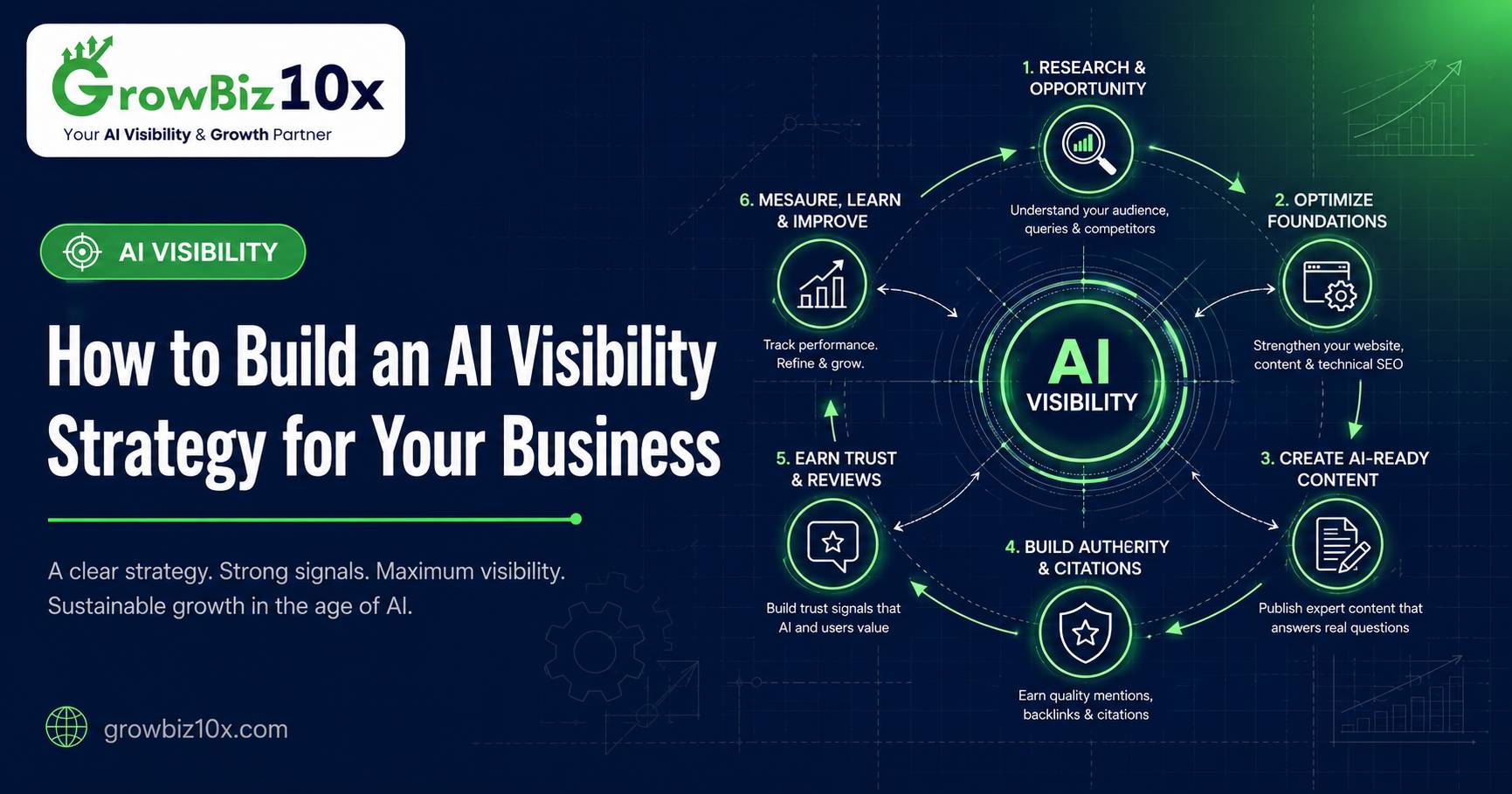
An AI visibility strategy is a documented plan for how your business will earn mentions and recommendations from AI answer engines. Building one takes six steps: set goals, audit your current AI presence, map your customers' questions, plan your content and entity work, assign ownership, and measure results. The point of a strategy, rather than scattered tactics, is focus: your resources go to the questions and platforms that actually produce customers.
Step 1: Set Goals That Match Your Business
Decide what winning looks like before you start. A local service business might aim to be named when assistants recommend providers in its area. A software company might target inclusion in comparison answers for its category. An agency might want to be cited as an authority on its specialty. Write down two or three concrete goals, such as being mentioned for a defined set of questions, correcting how AI describes you, or growing inquiries that arrive via AI platforms. Clear goals keep the rest of the plan honest.
Step 2: Audit Your Current AI Presence
Ask ChatGPT, Perplexity, Gemini, and Google AI Overviews your target questions and record the results: who is named, how you are described, what errors appear. Do the same for your top competitors. This audit tells you the size of the gap, which platforms matter most for your market, and which fixes are urgent. It also creates the baseline you will measure every future improvement against. For a structured template, How to Run an AI Visibility Audit breaks the audit into repeatable steps you can rerun each quarter.
Step 3: Map the Questions Your Customers Ask
List the real questions that lead people to businesses like yours, from early research to final comparison. Mine them from sales conversations, support tickets, reviews, and the phrasing your audit surfaced. Then prioritize: which questions have buying intent, which do you have a credible right to win, and which are your competitors already winning? This question map becomes the backbone of your content plan and the test set for your monitoring.
Step 4: Plan Your Content and Entity Work
Now translate the map into a work plan:
- Entity fixes: align your name, description, and details everywhere, and add schema markup.
- Answer pages: one focused page per priority question, with the direct answer up front.
- Proof assets: case studies, credentials, and specifics that back your claims.
- Authority outreach: reviews, directories, and mentions in sources your industry trusts.
Sequence matters: entity fixes first, then the highest-intent questions, then breadth. The content portion of the plan deserves its own blueprint; How to Build an AEO Content Strategy covers how to prioritize and structure answer pages.
Step 5: Assign Ownership and Set a Cadence
A strategy without owners is a wish. Name who owns entity data, who produces content, who drives reviews and outreach, and who runs monitoring. Set a realistic cadence, for example two answer pages per month and a monthly monitoring check, and protect it. Consistency compounds in AI visibility, because engines favor sources that are steadily active over those that publish in bursts and vanish.
Step 6: Measure What Matters
Re-run your audit questions on a schedule and track them against your baseline: mentions won, descriptions corrected, competitors displaced. Watch referral traffic and inquiries from AI platforms, and tag new customers by how they found you. Review the numbers quarterly, keep what is working, and reallocate effort from questions that stay stubborn to questions within reach. That loop, more than any single tactic, is the strategy. Choose a small set of indicators and stick with them; AI Visibility Metrics and KPIs Every Business Should Track lists the ones that reliably reflect progress.
Why a Written Strategy Beats Ad Hoc Effort
AI visibility work fails quietly when it is improvised: someone fixes a listing, someone else writes a post, nobody re-tests, and six months later no one can say what changed. A written strategy works because it forces the three commitments that produce results. First, explicit goals, so effort concentrates on the questions that actually drive revenue instead of scattering across everything. Second, named owners, so data accuracy, content, reviews, and monitoring each belong to a person rather than to everyone. Third, a measurement loop, so decisions come from evidence about what moved rather than from enthusiasm. Engines reward steady, consistent signals over bursts, and a documented plan is what makes consistency survive busy quarters.
A Worked Example: A Regional Accounting Firm
A twelve-person accounting firm wants to be recommended when businesses in its metro area ask assistants for tax and advisory help. Step one, it sets two goals: be named for small business tax planning in its city, and be described accurately on every major assistant. Step two, its audit finds it is absent from every recommendation, and one engine describes it as a bookkeeping service, underselling its advisory work. Step three, it maps eighteen client questions, from how to choose a CPA to industry-specific tax issues. Step four, the plan: fix the description everywhere, add schema, publish one answer page per week for the top questions, and gather reviews from advisory clients specifically, since those reviews corroborate the positioning it wants. Step five, the marketing manager owns content and monitoring, the office manager owns listings, and partners contribute one expert answer each month. Step six, the firm re-tests its eighteen questions monthly.
The plan fits on two pages. Its value is not sophistication; it is that every week the same fixed set of questions gets a little more evidence pointed at it. To see how each individual move lifts visibility, How to Improve AI Visibility for Your Business details the tactics this plan sequences.
Objections You Might Hear Internally
Our SEO agency already covers this. Ask them what they measure. If the answer is rankings and traffic, the AI answer layer is unmonitored: nobody is checking whether assistants name you, describe you accurately, or hand your category to a competitor. This strategy can sit alongside an SEO retainer; it fills a different gap.
We cannot justify it without hard attribution. You can measure more than you think: mention rates on a fixed question set, description accuracy, competitor share of recommendations, and referral traffic from AI platforms all trend clearly. Treat them as leading indicators, the same way rankings once earned their place in reports.
The field changes too fast for a plan. The plan is built on stable inputs: accurate data, focused content, earned trust, and measurement. Those survive model updates. What changes is the interface, which is exactly why the strategy fixes the question set and revisits platform priorities quarterly.
Frequently Asked Questions
How is an AI visibility strategy different from an SEO strategy?
They overlap but aim at different outcomes. SEO optimizes for rankings and clicks on results pages, while AI visibility optimizes for being named and accurately described inside generated answers. An AI visibility strategy adds entity consistency, quotable answer-first content, and third-party corroboration to the familiar SEO toolkit.
How much resource does this need?
Less than most channels to start. The audit and entity cleanup are days of work, and an achievable cadence of focused content and review generation sustains progress. The main investment is discipline: small, consistent effort beats an expensive one-off project in this channel.
When should I revisit the strategy itself?
Review quarterly and revise meaningfully once or twice a year, or sooner if a major platform shift changes how customers in your market ask questions. Your question map and baseline data make revisions straightforward, because you can see exactly what changed and where.
Related reading
- The Ultimate Guide to AI Visibility: What Businesses Need to Know in 2026
- AI Visibility Checklist for Businesses
- The Future of AI Visibility and Business Strategy
- From Audit to Authority: A 90-Day AI Visibility Roadmap
Put Your Strategy on Paper This Week
An AI visibility strategy does not need to be long; it needs to exist, with goals, a question map, owners, and a measurement loop. Businesses with a written plan consistently outpace those improvising tactic by tactic. Start with the evidence: run an AI visibility audit with GrowBiz10x and build your strategy on real data about how AI sees your business today. Block ninety minutes, write the six sections, and let your first monthly re-test tell you where to push. The plan you draft this week will already put you ahead of competitors who are still waiting for certainty.
Want to see how your business performs across AI platforms?
Get a free AI visibility audit and personalized insights for your brand.
About the Author
GrowBiz10x Team
AEO SpecialistWe share actionable insights on AI visibility, content strategy, and digital growth to help businesses get discovered and grow faster.
Related Posts

Categories
- Commercial / Agency / GrowBiz10x20
- Industry-Specific10
- Measuring AI Visibility10
- Practical AEO/GEO10
- SEO vs AEO vs GEO10
- Brand Signals & Authority10
- How AI Understands & Recommends Businesses10
- The Search Shift10
- Pillar: AI Visibility10
Get the latest insights in your inbox.
Subscribe to our newsletter and never miss an update.