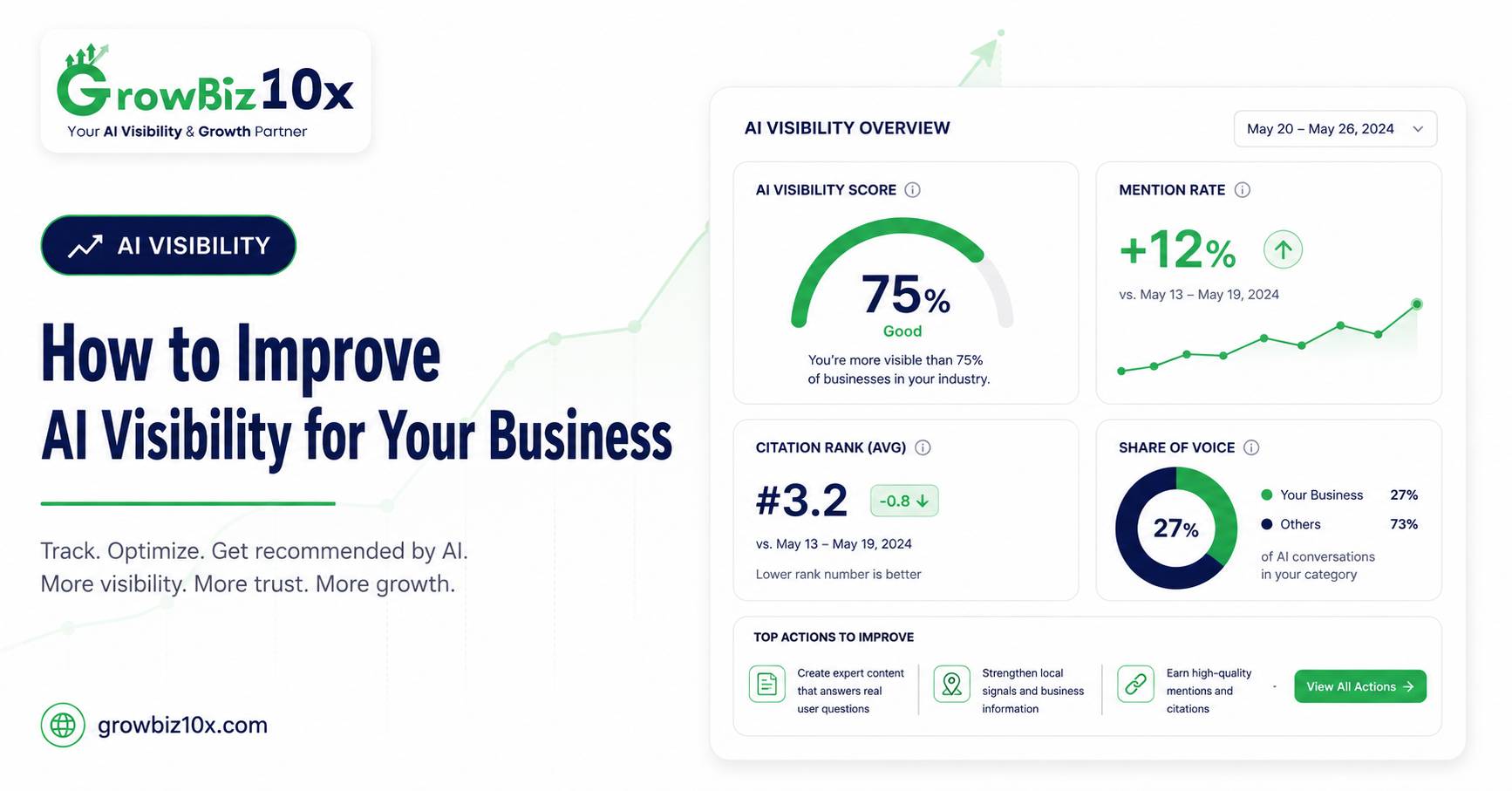
To improve AI visibility, make your business easy for machines to understand and easy for AI engines to trust. In practice, that means five moves: establish a baseline of how AI currently sees you, fix your entity data, publish content an AI can quote, build authority beyond your own website, and monitor the results. None of these require a big budget, but they do require consistency, and the businesses that do them methodically are the ones AI assistants end up recommending.
Establish Your Baseline
You cannot improve what you have not measured. Start by asking ChatGPT, Perplexity, Gemini, and Google AI Overviews the questions your customers actually ask: who is best for this problem, in this place, at this budget. Record whether you appear, how you are described, and who gets named instead of you. Then ask each assistant directly what it knows about your business. The gaps and errors you find become your work list, and the transcript becomes the benchmark you measure progress against. For a fuller measurement setup, How to Measure AI Visibility for Your Business walks through the questions, platforms, and logging cadence.
Strengthen Your Entity Foundations
AI engines think in entities, so your first fixes are about identity. Settle on one canonical name, one clear description of what you do and for whom, and one set of accurate details. Then apply them everywhere: your website, Google Business Profile, social accounts, industry directories, and review platforms. Add schema markup for your organization, locations, services, and FAQs so machines can read your facts directly instead of inferring them. This unglamorous cleanup is often the highest-leverage step, because inconsistency quietly disqualifies you from answers. For a deeper treatment of this identity work, see How to Build an Entity Foundation for Your Business.
Create Content AI Can Quote
Answer engines assemble responses from content that is easy to lift. Aim for pages with these traits:
- A direct answer to one clear question within the first two sentences.
- Specific facts, examples, and plain language instead of vague marketing claims.
- Descriptive headings that mirror how customers actually phrase their questions.
- FAQ sections that resolve related questions in one tight paragraph each.
- Regular updates, so engines see the page as current and trustworthy.
Depth beats breadth. A focused page for each important customer question gives engines precise material to cite, while one broad page forces them to guess. Well-built FAQ sections help here too; How FAQs Can Improve AI Search Visibility shows how to structure them so engines can lift each answer cleanly.
Build Authority Beyond Your Website
AI engines are cautious about self-praise; they trust what others say about you. Grow genuine customer reviews and respond to them. Pursue mentions in the publications, directories, and community sources your industry already trusts. Contribute expertise where your customers ask questions publicly. Every credible third-party reference is corroboration, and corroboration is what turns a claim on your website into a fact an AI will repeat.
Monitor, Measure, and Iterate
AI visibility is a moving target: models update, competitors improve, and answers change. Re-run your baseline questions on a regular schedule, track mentions and referral traffic from AI platforms, and watch for new inaccuracies. When a description improves or you enter a shortlist, note what changed and do more of it. Treat the whole cycle like any other growth channel: baseline, intervene, measure, repeat.
Why This Approach Works
These five moves are not a guess; they mirror how answer engines actually assemble recommendations. Engines retrieve evidence, cross-check it across independent sources, and quote what is clear and corroborated. Baseline testing tells you what the engines currently believe. Entity cleanup removes the contradictions that lower their confidence. Quotable content gives them liftable material that matches real questions. Earned authority supplies the independent corroboration they require before recommending anyone. Monitoring closes the loop so you keep investing where the engines respond.
Notice what is absent: tricks. There is no way to inject your brand into an answer directly, which is exactly why this evidence-based approach is durable. Everything you build here, consistent data, useful pages, genuine reviews, keeps its value as models change, because every engine needs the same raw material.
A Worked Example: A Local HVAC Company
Consider a heating and cooling company that serves three suburbs. Its baseline test is sobering: assistants recommend two competitors, describe the company with an outdated address, and miss its emergency service entirely. The fix list follows the five moves. Week one, the owner corrects the address and unifies the description across the website, Google Business Profile, and the four directories that matter locally. Weeks two and three, the team publishes three pages built around real questions: emergency furnace repair in its service area, replacement versus repair, and financing options. Each page opens with the direct answer and ends with a short FAQ. Over the following weeks, technicians start asking satisfied customers for reviews, and the owner answers questions in a local homeowners forum where the company can be cited by name.
By the next quarterly re-test, the emergency service question names the company and the address error is gone. No advertising spend changed; the evidence did.
Common Objections, Answered
We already invest in SEO. Keep investing; the work overlaps. But rankings are not mentions. A page can sit at position three and still never be quoted in a generated answer, and the gaps, entity consistency, third-party corroboration, review depth, are exactly what this process adds.
We do not have a content team. The volume required is smaller than classic SEO demands. A handful of genuinely useful answer pages, kept current, outperforms a large archive of thin posts. One focused page a month is a workable cadence for most small teams.
AI search is too new to prioritize. The signals engines rely on take months to build, which means starting after your competitors are established is the expensive option. Early effort compounds while attention in your category is still scarce.
Frequently Asked Questions
What is the single fastest way to improve AI visibility?
Fix consistency first. Aligning your name, description, and key details across your website, profiles, and directories removes the contradictions that make engines hesitant to recommend you, and it typically takes days rather than months. Content and authority building deliver bigger gains, but they build on that clean foundation.
Do I need new tools to work on AI visibility?
You can start manually by querying the major assistants and keeping a simple log. Dedicated platforms like GrowBiz10x make this sustainable by tracking how multiple AI engines mention, describe, and recommend your business over time, so you see trends and catch problems without hours of manual checking.
Will improving AI visibility hurt my traditional SEO?
No, the two reinforce each other. Clear structure, direct answers, structured data, and third-party authority are rewarded by both classic search rankings and AI answer engines. Most businesses find that AI visibility work simply extends the value of what good SEO already taught them.
Related reading
- The Ultimate Guide to AI Visibility: What Businesses Need to Know in 2026
- AI Visibility Checklist for Businesses
- How AI Determines Whether a Business Is Relevant
- From Audit to Authority: A 90-Day AI Visibility Roadmap
Start Improving How AI Recommends You
Improving AI visibility is a sequence of practical steps, not a mystery: baseline, clean data, quotable content, earned authority, steady monitoring. Every week you delay, the assistants keep answering your customers' questions with someone else's name. Run an AI visibility audit with GrowBiz10x to get your baseline and a prioritized plan for winning more AI recommendations. The audit shows you the questions where you are missing, the errors engines repeat about you, and the competitors currently taking your recommendations, so your first fix list writes itself. Start this week, and your next quarterly re-test becomes your proof.
Want to see how your business performs across AI platforms?
Get a free AI visibility audit and personalized insights for your brand.
About the Author
GrowBiz10x Team
AEO SpecialistWe share actionable insights on AI visibility, content strategy, and digital growth to help businesses get discovered and grow faster.
Related Posts

Categories
- Commercial / Agency / GrowBiz10x20
- Industry-Specific10
- Measuring AI Visibility10
- Practical AEO/GEO10
- SEO vs AEO vs GEO10
- Brand Signals & Authority10
- How AI Understands & Recommends Businesses10
- The Search Shift10
- Pillar: AI Visibility10
Get the latest insights in your inbox.
Subscribe to our newsletter and never miss an update.