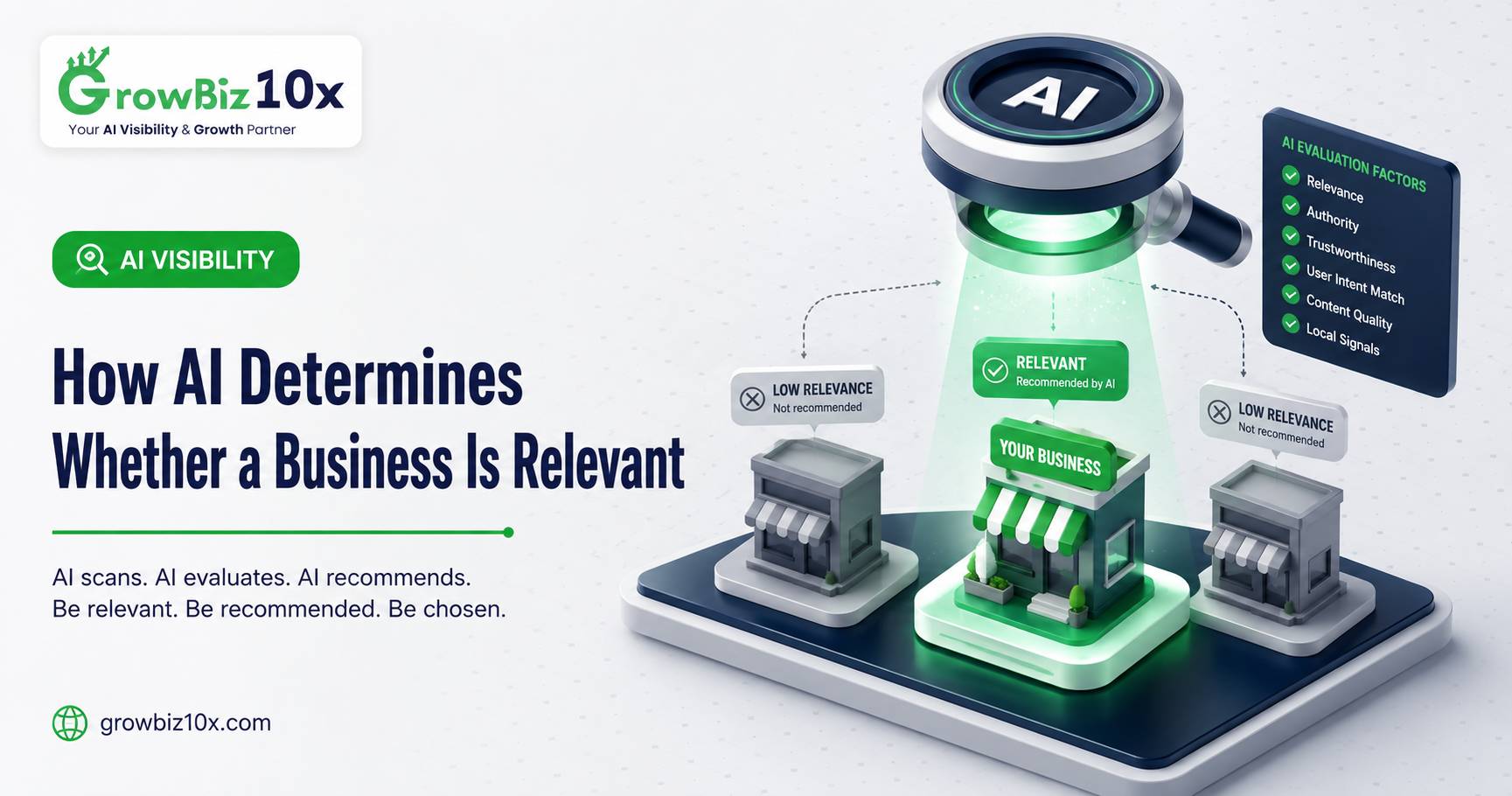
AI systems determine whether a business is relevant by matching the intent behind a user's question against everything they know about that business. That knowledge comes from two places: what the model absorbed during training, and what it retrieves live from websites, listings, reviews, and articles at the moment of the question. If those sources clearly and consistently connect you to the topic being asked about, you are a candidate for the answer; if they are vague or contradictory, you are filtered out before the response is ever written.
How AI Systems Learn About Your Business
Large language models build an internal picture of your business as an entity: a named thing with attributes such as an industry, a location, services, and a reputation. During training they absorb every public mention of you, and at answer time many engines also retrieve current pages to check the facts. This means your relevance is shaped by your entire footprint, including old directory entries, review responses, press coverage, and forum threads, not just the pages you actively maintain. This entity model is central to everything that follows; What Is an Entity and Why Does AI Care About Yours? explores it in more depth.
The Signals That Shape Relevance
- Entity clarity - a machine can state precisely what you do, for whom, and where, without guessing.
- Consistency - your name, description, and details match everywhere they appear across the web.
- Topical depth - substantial, specific content that demonstrates real expertise in your niche.
- Third-party authority - mentions in trusted publications, directories, and industry sources you do not control.
- Reviews and sentiment - independent evidence of customer experience and satisfaction.
- Freshness - recent activity that shows the information is current and the business is alive.
Context Decides Everything: Relevance Is Per Question
There is no single relevance score for your business. An engine may consider you highly relevant for one question and invisible for the next, because relevance is computed against each specific query. A detailed question about a niche use case, a location, or a budget gets matched against equally specific evidence. This is why broad claims like industry-leading solutions rarely earn citations, while a concrete page that addresses one situation in depth often does. The businesses that win AI recommendations tend to cover the actual question space of their customers rather than a handful of generic themes.
A Worked Example: One Question, Two Candidates
A homeowner asks an assistant for a roofer who works with historic houses and offers financing. Roofer A has more reviews overall and a bigger website, but nothing about historic homes or payment plans. Roofer B has a page describing restoration work on older houses, notes financing on its services page, and has several reviews that mention historic properties. For this question, the engine judges Roofer B more relevant: its evidence matches more of the question's requirements, and independent reviews corroborate the match. Ask a different question, say the cheapest same-day repair, and the judgment could flip. You do not raise relevance in general; you raise it question by question, by documenting the specific claims you want engines to match. It is the same evaluation described in How AI Engines Decide Which Businesses to Recommend, applied one query at a time.
Why Consistency Beats Volume
An AI engine that finds three conflicting descriptions of your business does not average them. It loses confidence in all three.
Models prefer corroborated facts. When multiple independent sources agree about who you are and what you do, the engine can state it confidently and recommend you. When sources conflict, hedging or omission is the safer path for the machine, and omission is what you feel as lost visibility. A modest but perfectly consistent footprint routinely outperforms a large, contradictory one. Getting every listing to agree is unglamorous but high leverage; How Consistent Business Information Improves AI Visibility covers the process.
How to Strengthen Your Relevance Signals
- Write a clear, factual one-paragraph definition of your business and use it consistently across your site and profiles.
- Audit directories, social profiles, and listings for outdated or conflicting details, and fix them.
- Map the specific questions customers ask and publish a focused page for each important one.
- Add schema markup for your organization, services, locations, and FAQs.
- Build genuine reviews and pursue mentions in the sources your industry already trusts.
Frequently Asked Questions
Can I directly tell an AI engine that my business is relevant?
Not in the way you submit a sitemap to a search engine. You influence AI systems indirectly, by shaping the evidence they read: your site, structured data, listings, reviews, and third-party coverage. The engines draw their own conclusions, which is why the quality and consistency of that evidence matters so much.
Do paid ads improve how relevant AI thinks my business is?
Advertising can appear in some AI-powered experiences, but it does not change the underlying relevance judgment in organic answers. Engines base recommendations on the evidence in their training data and retrieved sources, so earned signals like content, reviews, and citations are what move the needle.
How often do AI systems update what they know about my business?
It varies by platform. Retrieval-based engines can pick up changes as soon as they recrawl your pages, while knowledge baked into a model updates more slowly with new model versions. Practically, publish corrections and improvements now; different engines will absorb them on different schedules.
Related reading
- What Is AI Visibility? A Complete Guide for Businesses
- What Is AI Search and How Does It Work?
- AI Visibility Checklist for Businesses
- What Sources Do AI Engines Trust When Recommending Businesses?
Make Your Relevance Obvious to Machines
AI engines are not mysterious judges; they are pattern readers working from the evidence your business leaves across the web. Make that evidence clear, consistent, and credible, and relevance follows. GrowBiz10x helps you see exactly what the engines currently believe about your business and where the signals are weak. Run an AI visibility audit with GrowBiz10x and find out how relevant AI thinks you are today.
Want to see how your business performs across AI platforms?
Get a free AI visibility audit and personalized insights for your brand.
About the Author
GrowBiz10x Team
AEO SpecialistWe share actionable insights on AI visibility, content strategy, and digital growth to help businesses get discovered and grow faster.
Related Posts

Categories
- Commercial / Agency / GrowBiz10x20
- Industry-Specific10
- Measuring AI Visibility10
- Practical AEO/GEO10
- SEO vs AEO vs GEO10
- Brand Signals & Authority10
- How AI Understands & Recommends Businesses10
- The Search Shift10
- Pillar: AI Visibility10
Get the latest insights in your inbox.
Subscribe to our newsletter and never miss an update.