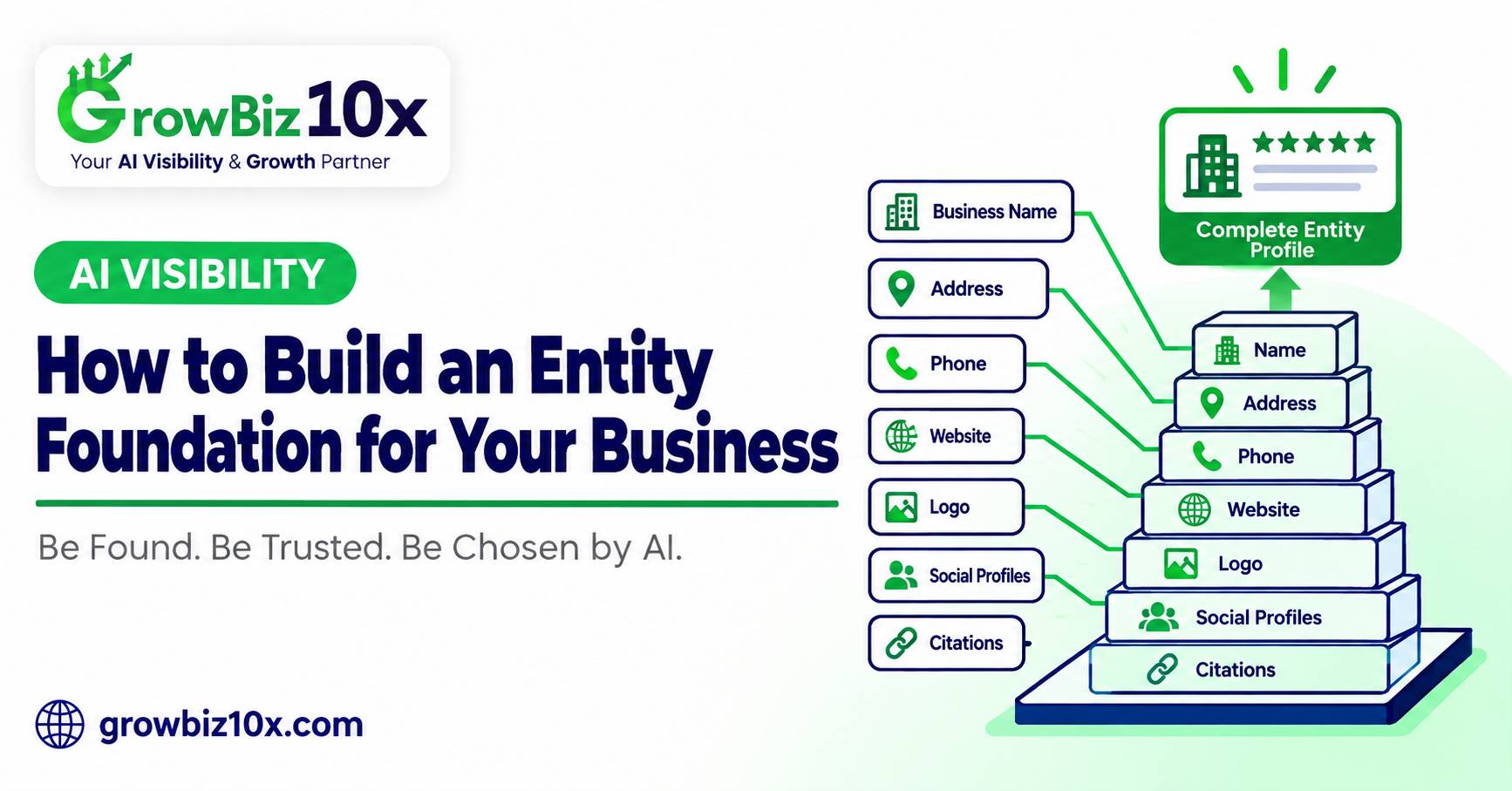
An entity foundation is the set of clear, consistent, verifiable facts that tells AI systems exactly who your business is, what it does, where it operates, and why it deserves trust. You build one by defining your identity precisely on your own website, confirming those same facts on authoritative third-party platforms, and connecting everything with structured data. Get this right and answer engines like ChatGPT, Perplexity, and Google AI Overviews can recognize and recommend your business with confidence.
What an Entity Foundation Is and Why It Matters
AI answer engines do not rank pages the way traditional search engines do. They assemble answers from what they know and can verify about real-world entities: companies, people, products, and places. If your business exists in their understanding as a well-defined entity with consistent facts attached, you become a safe recommendation. If your identity is vague or contradictory, engines hesitate, and the recommendation goes to a competitor whose facts line up. If the concept is new, start with our primer on what an entity is and why AI cares about yours.
Think of an entity foundation as the machine-readable version of your reputation. Everything else you do for AI visibility builds on top of it.
Step 1: Define Your Entity on Your Own Website
Your website is the primary source AI engines use to understand who you are, so give them a clean, unambiguous definition to work with.
- Use one canonical business name everywhere, including your logo, footer, title tags, and legal pages.
- Write a one-sentence description of what you do, for whom, and where, then repeat it on your homepage and About page.
- Give each core service or product its own page with a plain-language explanation.
- Publish your address, phone number, service area, and founding details where they are easy to find.
Step 2: Claim and Complete Authoritative Profiles
AI engines cross-reference your website against sources they already trust, and the more high-quality places confirm the same facts, the more confident an engine becomes. Prioritize your Google Business Profile, LinkedIn company page, Bing Places, the leading directories in your industry, and the review platforms your customers actually use. Complete every field, use your canonical name and description, and link back to your website. A half-finished profile is a weak signal, and an abandoned profile with outdated facts is an active contradiction.
Step 3: Connect Everything With Schema Markup
Structured data lets you describe your business to machines in their own language. Add Organization or LocalBusiness schema to your homepage with your name, logo, address, phone number, and founding date. Use the sameAs property to point to your official profiles so engines know those accounts belong to the same entity. Add Service, Product, and FAQ schema where they fit. None of this is visible to human visitors, but it removes guesswork for every AI system that reads your site. For implementation details, see our guide to how schema markup supports AI search optimization.
Step 4: Keep Your Entity Consistent as You Grow
Entity foundations erode quietly. A rebrand, an office move, a new phone system, or a well-meaning employee editing a directory listing can reintroduce contradictions. Keep a single source-of-truth document with your approved name, description, address, and links, and review your major profiles on a regular schedule. When something changes, update your website first, then push the change everywhere else.
AI engines recommend businesses they can verify. Consistency is not a cosmetic detail; it is the evidence.
A Worked Example: Making One Firm Unmistakable to AI
Imagine a ten-person accounting firm that specializes in bookkeeping and tax work for independent restaurants. Its website calls it a financial solutions partner, its Google Business Profile still shows the address of an office it left years ago, and its LinkedIn page describes a service mix it no longer offers. When an answer engine is asked to recommend a restaurant accountant in its city, the engine finds three partial versions of the firm, cannot confidently merge them, and recommends competitors whose records line up.
Now walk the fix. First, the firm rewrites its homepage and About page around one plain sentence: the name, what it does, who it serves, and where it operates. Second, it updates its Google Business Profile, LinkedIn page, Bing Places listing, and the two accounting directories that matter in its niche until every field matches that sentence. Third, it adds Organization schema with its name, logo, address, phone number, and sameAs links pointing at those profiles. Finally, it retires the outdated service pages and sets a quarterly reminder to recheck every listing. Nothing about the firm's actual expertise changed, but its machine-readable story went from three conflicting drafts to one confirmed record. That is the entire point of an entity foundation: engines no longer have to guess which version of you is true.
A 30-Day Entity Foundation Build Plan
You do not need months to lay the groundwork. Here is a realistic sequence for a small team:
- Days 1 to 5: Write your source-of-truth document with your canonical name, one-sentence description, address, phone number, hours, service list, and founding details.
- Days 6 to 10: Update your homepage, About page, contact page, and footer so every fact matches that document exactly.
- Days 11 to 15: Add Organization or LocalBusiness schema to your site, including the sameAs property pointing to your official profiles.
- Days 16 to 22: Claim and complete your Google Business Profile, LinkedIn page, Bing Places, and the top directories and review platforms in your industry.
- Days 23 to 27: Search your old names, addresses, and phone numbers, then correct or remove every outdated or duplicate listing you find.
- Days 28 to 30: Document the maintenance routine: who owns business information, how changes roll out, and when quarterly checks happen.
Common Mistakes That Weaken an Entity Foundation
Most entity problems are not exotic. The same handful of mistakes shows up in almost every audit:
- Using different versions of the business name across the website, profiles, and legal pages, which splits your identity into competing records.
- Treating schema as a one-time task and letting it drift out of date after a move, rebrand, or service change.
- Leaving old listings alive after a move instead of correcting or removing them, so engines keep finding the outdated address.
- Writing descriptions in slogan language that never states what the business actually does or where it operates.
- Spreading effort across every platform available instead of completing the handful of profiles engines actually trust.
- Assuming no news is good news and never checking what AI engines currently say about the business.
Objections Worth Answering
This feels like busywork compared to marketing. It is closer to infrastructure than marketing. Campaigns buy attention; an entity foundation determines whether AI engines can act on that attention. Every recommendation an engine makes passes through the question of whether it can verify you, and no campaign fixes a failed verification.
My customers do not use AI search yet. Some already do, and the engines learning about your business today are shaping the answers they will give for years. Entity signals build slowly, which is exactly why waiting until AI referrals are obvious means starting from behind.
We rank well on Google, so we must be fine. Rankings and entity recognition are related but separate. A page can rank for keywords while the business behind it remains poorly defined as an entity, which is why some businesses rank well and still never appear in AI recommendations.
Adjacent Terms Worth Knowing
Entity work comes with vocabulary that is easy to mix up. Quick definitions:
- Entity: a distinct thing machines can identify, such as a company, person, product, or place, with facts attached to it.
- Knowledge graph: a database of entities and the relationships between them that AI systems consult when assembling answers.
- NAP consistency: keeping your name, address, and phone number identical across the web so engines can match every record to one business.
- Structured data: machine-readable code, usually schema markup, that states facts about your pages and your organization directly.
- sameAs: the schema property that tells machines which external profiles belong to the same entity as your website.
- E-E-A-T: shorthand for experience, expertise, authoritativeness, and trustworthiness, the qualities engines weigh when judging sources.
How the Pieces Fit Together
An entity foundation is the base layer of a larger trust system, and the rest of this cluster builds directly on it. The definition work starts on your own site; our guide to creating an About page AI engines understand turns one page into the clearest identity statement you own. From there, consistent business information across the web keeps every external copy of your facts aligned with your site.
Once the facts are stable, the trust layers stack on top: verifiable expertise signals, independent reviews, third-party validation, digital PR, and thought leadership that earns citations. Each of those signals lands harder because engines already know exactly which entity it attaches to. Build the foundation first, then compound it.
Frequently Asked Questions
How long does it take for AI engines to recognize a business entity?
There is no fixed timeline. Engines update their understanding as they recrawl your site and the sources they trust, so recognition tends to strengthen over weeks and months rather than days. The more consistent and widely confirmed your facts are, the faster that confidence builds.
Do small local businesses really need schema markup?
Yes. Schema is one of the few direct channels you have for describing your business to machines, and it costs little to implement. For a local business, LocalBusiness schema combined with a complete Google Business Profile is one of the highest-leverage pairings available.
Is an entity foundation different from traditional SEO?
It overlaps but is not identical. Traditional SEO optimizes individual pages for rankings, while an entity foundation makes your business itself legible to AI systems. Strong pages built on a weak entity can still be passed over when an engine assembles a recommendation.
Do I need a Wikipedia page to be recognized as an entity?
No. Wikipedia helps when it exists, but most small and midsize businesses will never qualify for a page and do not need one. Complete profiles, consistent facts, schema markup, and steady third-party mentions are enough for engines to recognize and trust your entity.
Can an online-only business build an entity foundation?
Yes. Skip the location signals that do not apply and lean harder on everything else: a precise definition of what you do and who you serve, complete profiles, schema markup, named founders with verifiable bios, and identical facts on every platform where you appear.
What is the single highest-leverage first step?
Write the source-of-truth document and fix your own website to match it. Everything downstream, from profiles to schema to directories, copies from that master record, so getting it right first prevents you from propagating a flawed version of your identity.
Related reading
- E-E-A-T for AI Search: Building Trust Signals AI Can Verify
- Digital PR for AI Visibility: Earning Mentions That Matter
- Building Topical Authority So AI Sees You as the Expert
- How Customer Reviews Build AI Trust in Your Brand
- Third-Party Validation: Why AI Needs Others to Vouch for You
- How to Audit Your Brand's Trust Signals for AI Search
Conclusion: Lay the Foundation Before You Scale Content
Publishing content on top of an undefined entity is building on sand. Define your business clearly on your site, confirm it across trusted platforms, wire it together with schema, and keep it consistent as you grow. GrowBiz10x audits your entity signals, shows you exactly where AI engines get confused, and gives you a prioritized plan to fix it. Start your AI visibility audit with GrowBiz10x today and give every answer engine a reason to recommend you.
Want to see how your business performs across AI platforms?
Get a free AI visibility audit and personalized insights for your brand.
About the Author
GrowBiz10x Team
AEO SpecialistWe share actionable insights on AI visibility, content strategy, and digital growth to help businesses get discovered and grow faster.
Related Posts

Categories
- Commercial / Agency / GrowBiz10x20
- Industry-Specific10
- Measuring AI Visibility10
- Practical AEO/GEO10
- SEO vs AEO vs GEO10
- Brand Signals & Authority10
- How AI Understands & Recommends Businesses10
- The Search Shift10
- Pillar: AI Visibility10
Get the latest insights in your inbox.
Subscribe to our newsletter and never miss an update.