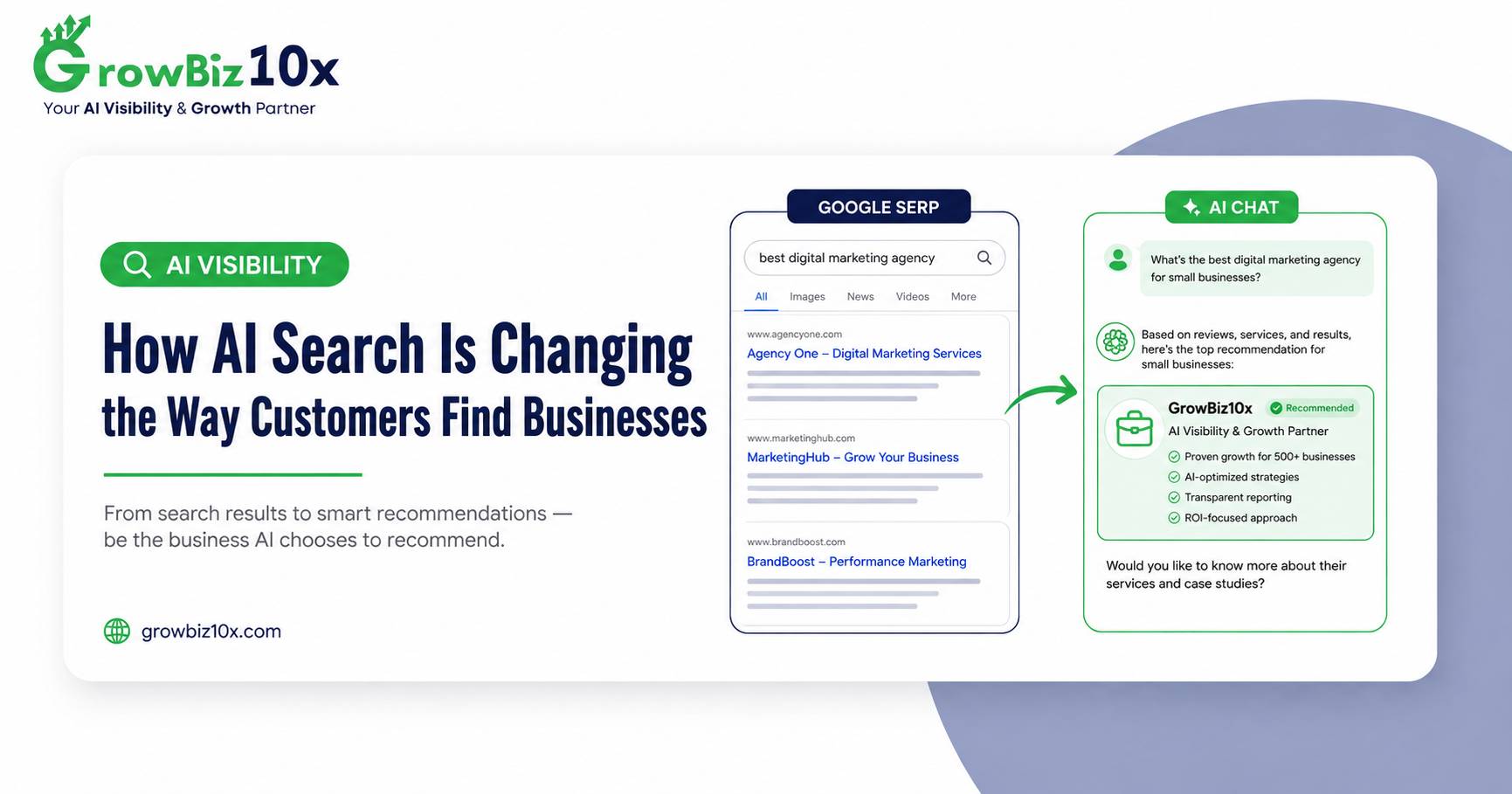
AI search is changing the way customers find businesses by replacing pages of ranked links with direct answers and short recommendation lists. Instead of comparing ten results, a customer now asks an assistant a question, receives a synthesized answer naming a few options, and often makes a decision without ever browsing. For businesses, that means discovery increasingly happens inside AI conversations you never see, based on information you may not even know exists.
From Searching to Asking
Customers used to translate their needs into short keyword phrases and then do the research themselves. Now they describe their situation in full sentences: the budget, the location, the constraint, the deadline. They ask follow-up questions and refine the answer in a back-and-forth conversation. This shift rewards businesses whose online presence answers detailed, specific questions, because AI engines match rich queries against rich content. A page that only targets a generic keyword gives the engine little to work with when the question is precise. If you want the mechanics behind this shift, What Is AI Search and How Does It Work? explains how engines turn a conversational question into a short answer.
The Rise of the Zero-Click Journey
A growing share of research now ends inside the answer itself. The customer reads the AI's summary, compares the named options, and only clicks through when they are close to a decision, if they click at all. That compresses the funnel: awareness, comparison, and shortlisting can all happen in one AI response. It also means your first impression is often written by the AI, not by you. How the engine describes your pricing, specialty, and reputation becomes your storefront, which makes accuracy across the web a revenue issue rather than a housekeeping task. This pattern has a name and is reshaping metrics across the industry; see What Are Zero-Click AI Searches and Why Do They Matter?.
A Worked Example: Choosing an Accountant Without a Single Search
A founder preparing for her first tax season asks an assistant: I run a two-person online store, what should I look for in an accountant, and who handles ecommerce in Denver? The assistant explains what matters, then names three firms, noting that one specializes in online sellers and has reviews mentioning marketplace bookkeeping. She asks two follow-up questions about pricing and switching costs, gets clear answers, and emails that firm directly. She never visited a results page and never saw the other firms that a traditional search would have listed. The winning firm did nothing special that week; months earlier it had published a page about ecommerce accounting and collected reviews from online-store clients, which was exactly the evidence the assistant needed.
Shortlists Replace Rankings
In traditional search you could win a click from position five. In an AI answer, there is no position five.
AI responses typically name just a few businesses, and users tend to trust that the filtering has already been done for them. Being included is the new page one, and being excluded is silence. This raises the stakes of the trust signals AI engines lean on: consistent business data, credible reviews, third-party mentions, and content that plainly demonstrates expertise in the exact niche the customer asked about. Understanding why an engine picks rivals over you is its own discipline, and Why AI Recommends Your Competitors Instead of You breaks down the usual causes.
What This Means for Local and Niche Businesses
The news is not all threatening. AI search often favors specific, well-documented businesses over big generic brands, because detailed questions demand detailed answers. A local service provider with accurate listings, genuine reviews, and clear service descriptions can be exactly what the engine needs to answer a query like the best option for a particular neighborhood, budget, or use case. Specialists who publish deep content about their niche give AI engines a reason to cite them that a broad competitor cannot match.
How to Adapt Your Discovery Strategy
- Ask major AI assistants the questions your customers ask, and document who gets recommended today.
- Rewrite key pages to answer specific customer situations, not just generic keywords.
- Make your business data consistent everywhere an AI might read it, from your site to directories and profiles.
- Grow authentic reviews and third-party mentions, because engines lean on independent validation.
- Track AI-driven referrals and mentions monthly, and treat changes as an early warning system.
Frequently Asked Questions
Will customers stop visiting business websites?
Visits are becoming fewer but warmer. Many customers arrive after an AI has already answered their basic questions, so they show up closer to a decision. Your website still matters, both as the source AI engines read and as the place high-intent visitors go to convert.
How do I know if AI search is affecting my business?
Ask the major assistants your core customer questions and see whether you appear, then watch your analytics for referral traffic from AI platforms and for shifts in branded searches. Many businesses first notice the change as fewer top-of-funnel visits but steadier demand from people who already know exactly what they want.
Is this shift only relevant for online businesses?
No. Local and offline businesses may feel it most, because recommendation-style questions like who is the best nearby are precisely what AI assistants are good at answering. If AI engines cannot verify who you are and what you do, they will recommend a competitor they can verify.
Related reading
- What Is AI Visibility? A Complete Guide for Businesses
- What Does AI Visibility Mean for Your Business?
- How to Improve AI Visibility for Your Business
- How AI Is Changing Local Business Discovery
Stay Discoverable as the Rules Change
Customer discovery is moving into AI conversations, and the businesses that adapt early will be the ones getting named while others wonder where their traffic went. The first step is simply knowing how you show up today. Run an AI visibility audit with GrowBiz10x and see exactly what AI engines are telling your future customers about you.
Want to see how your business performs across AI platforms?
Get a free AI visibility audit and personalized insights for your brand.
About the Author
GrowBiz10x Team
AEO SpecialistWe share actionable insights on AI visibility, content strategy, and digital growth to help businesses get discovered and grow faster.
Related Posts

Categories
- Commercial / Agency / GrowBiz10x20
- Industry-Specific10
- Measuring AI Visibility10
- Practical AEO/GEO10
- SEO vs AEO vs GEO10
- Brand Signals & Authority10
- How AI Understands & Recommends Businesses10
- The Search Shift10
- Pillar: AI Visibility10
Get the latest insights in your inbox.
Subscribe to our newsletter and never miss an update.