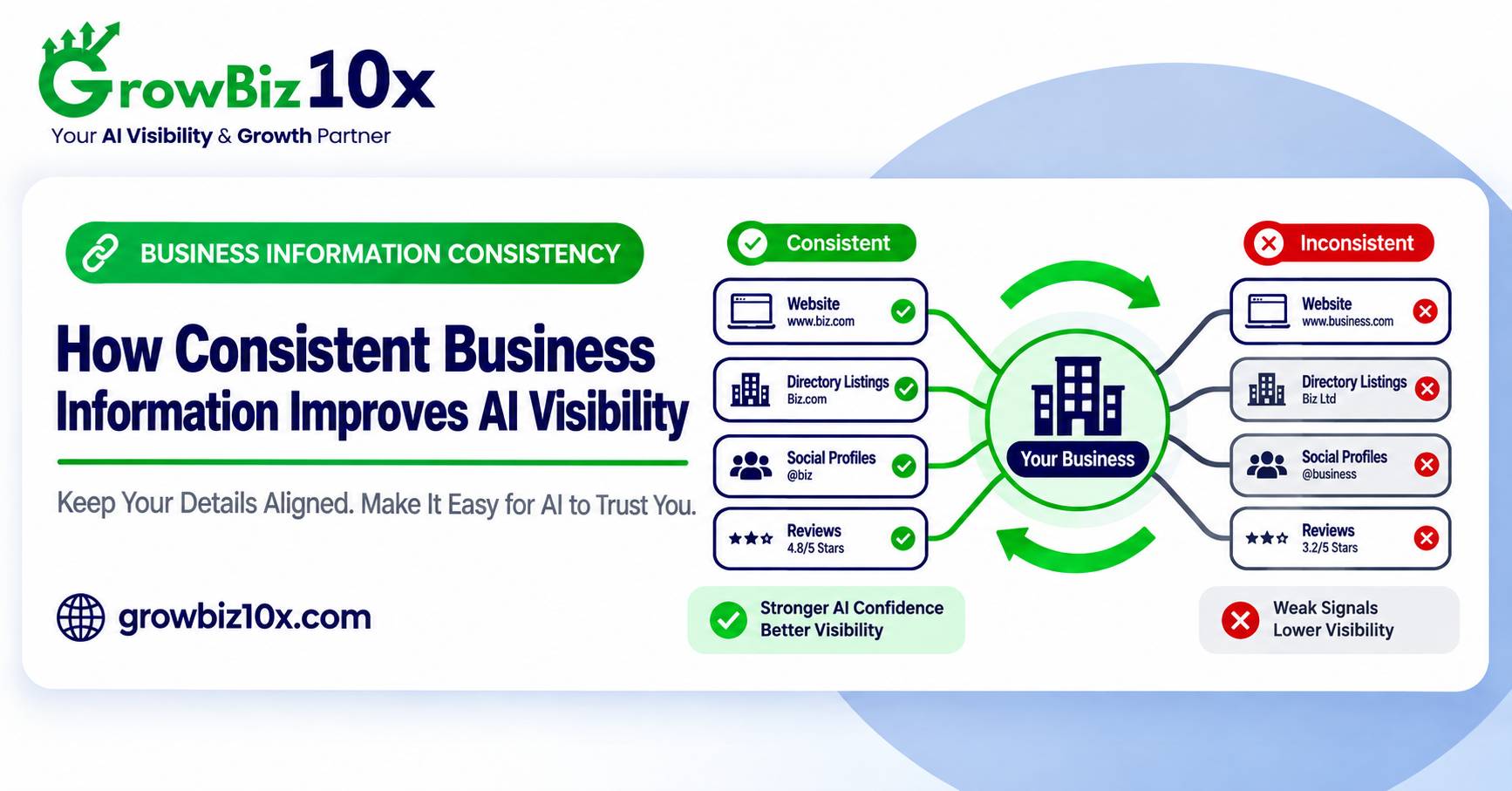
Consistent business information improves AI visibility because answer engines verify facts across many sources before they recommend anyone. When your name, address, and phone number match everywhere, engines treat your business as one legitimate, active entity; when they conflict, engines lose confidence and quietly leave you out of answers. This is why NAP consistency, long a local SEO staple, has become a core AI visibility discipline.
Why AI Engines Cross-Check Your Business Details
An AI engine recommending a business is making a small promise to its user: this company exists, is open, and can be reached. To keep that promise, engines compare what your website says against what maps platforms, directories, review sites, and social profiles say. Agreement across independent sources is the closest thing a machine has to proof. Disagreement raises hard questions: Which address is current? Are these two listings the same company or different ones? Is this business still operating? Engines rarely resolve those questions in your favor; they just pick a business with no questions attached. This verification habit sits at the heart of how AI engines decide which businesses to recommend.
Where AI Looks for Your Business Information
Your information footprint is bigger than most owners realize. The places that matter most include:
- Your website, including the footer, contact page, and schema markup.
- Google Business Profile and Bing Places.
- Apple Maps and other mapping services.
- Major review platforms such as Yelp, Trustpilot, or the leaders in your industry.
- Industry and local directories, chambers of commerce, and association listings.
- Social profiles on LinkedIn, Facebook, and Instagram.
- Data aggregators that feed dozens of smaller sites.
How Inconsistencies Creep In
Almost no business sets out to publish conflicting information; it accumulates. A move leaves the old address alive in forgotten directories. A rebrand changes the name on the website but not on decade-old listings. A tracking phone number gets pasted into a profile and never removed. Someone creates a duplicate Google listing during a busy week. Minor formatting differences like Street versus St are generally harmless, but genuinely conflicting facts, such as two different addresses or phone numbers, are the contradictions that erode machine trust.
A Step-by-Step Cleanup Process
- Create a source-of-truth document with your exact business name, address, phone number, hours, website, and one-sentence description.
- Inventory your listings by searching your business name, old names, old addresses, and every phone number you have used.
- Fix the highest-authority sources first: your website and schema, Google Business Profile, Bing Places, and Apple Maps.
- Correct or remove duplicate and outdated listings, using each platform's ownership or removal process.
- Update the remaining directories and social profiles to match your source of truth exactly.
- Recheck the full list on a quarterly schedule, because third-party data has a way of drifting back.
Keep It Consistent Going Forward
Consistency is a habit, not a project. Assign one owner for business information, route every change through the source-of-truth document, and update your website and schema before anything else. When you move, change numbers, or rebrand, treat listing updates as part of the launch checklist rather than an afterthought. The businesses that stay visible in AI answers are the ones whose facts never give engines a reason to pause.
A Worked Example: The Move That Split One Business in Two
Consider a hypothetical HVAC company that moved across town three years ago. Its website and Google Business Profile show the new address, but an old Yelp listing, two data aggregators, and a chamber of commerce page still show the previous one, and a duplicate Google listing created during the move survives with the old phone number. To a machine, this looks less like one company that moved and more like two similar companies with conflicting details. The cleanup follows the process above: the owner writes the source-of-truth document, merges the duplicate Google listing, corrects Yelp and the chamber page, and submits fixes to the aggregators feeding the smaller sites. Within a few months every surviving record tells the same story, and engines evaluating the company finally see one business, one address, one number. The same single-version rule should start on your own site, beginning with an About page AI engines understand.
Frequently Asked Questions
Does small formatting variation hurt AI visibility?
Minor formatting differences such as Suite versus Ste or Road versus Rd are generally understood by modern systems. The real damage comes from substantive conflicts: different phone numbers, different addresses, mismatched business names, or listings that say you are closed when you are open.
Do I need a paid citation management service?
Not necessarily. A small business with a modest footprint can do the cleanup manually using the process above. Paid services save time when you have many locations, a long history of moves or rebrands, or no capacity to maintain listings quarterly.
How quickly do AI engines reflect corrected information?
It depends on how often each engine refreshes its sources. Some corrections surface quickly, while others take weeks to propagate through aggregators and recrawls. The important part is that every correction permanently removes a contradiction that was working against you.
Related reading
- How to Build an Entity Foundation for Your Business
- How to Audit Your Brand's Trust Signals for AI Search
- Do Directories and Wikipedia Still Matter for AI Visibility?
Conclusion: Boring Consistency, Real Visibility
Consistent business information is not glamorous work, but it is foundational: every AI recommendation you will ever earn rests on engines believing your basic facts. Clean up the conflicts once, then guard the standard. GrowBiz10x scans how AI engines and the sources they trust currently describe your business, flags the contradictions, and prioritizes the fixes. Check your business information health with GrowBiz10x today and stop losing recommendations to avoidable doubt.
Want to see how your business performs across AI platforms?
Get a free AI visibility audit and personalized insights for your brand.
About the Author
GrowBiz10x Team
AEO SpecialistWe share actionable insights on AI visibility, content strategy, and digital growth to help businesses get discovered and grow faster.
Related Posts

Categories
- Commercial / Agency / GrowBiz10x20
- Industry-Specific10
- Measuring AI Visibility10
- Practical AEO/GEO10
- SEO vs AEO vs GEO10
- Brand Signals & Authority10
- How AI Understands & Recommends Businesses10
- The Search Shift10
- Pillar: AI Visibility10
Get the latest insights in your inbox.
Subscribe to our newsletter and never miss an update.