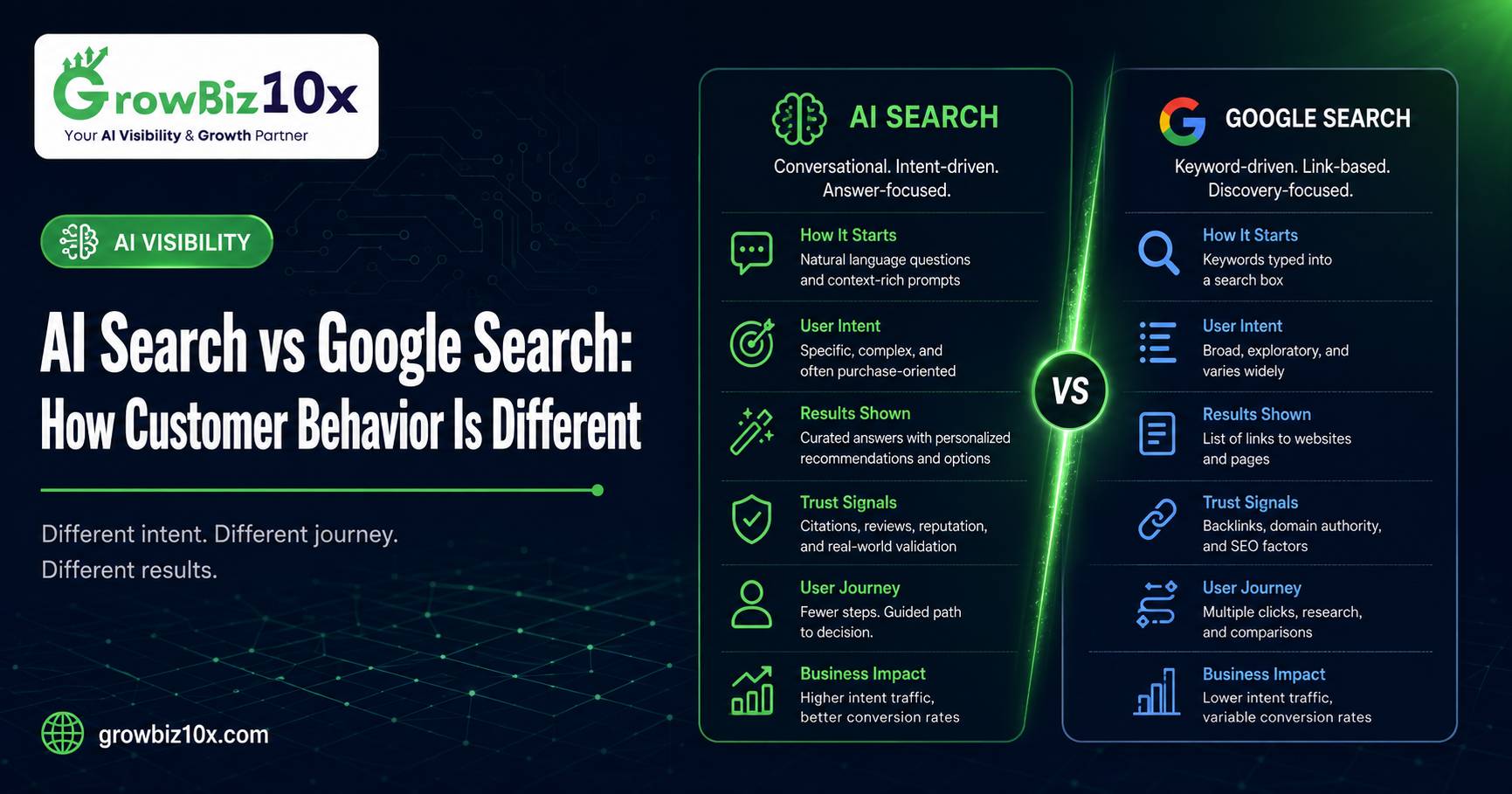
Customer behavior in AI search differs from Google search in three fundamental ways: how people phrase queries, how long they stay in one session, and how rarely they click through to websites. Google trained users to type keywords, scan results, and open tabs. AI assistants train them to describe a need, converse, and accept a synthesized answer. Each behavior shift changes what businesses must do to be found.
Query Style: Fragments vs Briefs
Google queries are compressed fragments: a service name, a city, maybe the word best. AI queries read like briefs, complete with context, constraints, and preferences. That extra detail lets the assistant filter aggressively before a human ever sees an option. For businesses, ranking for a head keyword no longer guarantees presence in the conversation; you need content that matches the detailed, qualified questions people actually ask assistants. This shift in phrasing is a big part of how conversational search is changing SEO.
Example: The Same Buyer on Two Platforms
Watch one buyer run the same task both ways. On Google she types accounting software small business, scans two ads and a listicle, opens five tabs, and starts comparing pricing pages herself. On ChatGPT she writes: I run a six-person design studio, I invoice internationally, and my bookkeeper uses a Mac; what accounting software should I use? The assistant returns three options matched to her constraints, and her next message, which one is easiest to migrate to from spreadsheets, replaces another round of tab-opening. Same person, same need, entirely different behavior: one platform made her the researcher, the other made her the editor of a finished comparison. Your business has to be findable in the first world and quotable in the second.
Session Shape: Many Searches vs One Conversation
A Google research session is a series of separate searches, each a fresh start. An AI session is cumulative: the assistant remembers the budget mentioned three messages ago and applies it to every suggestion after. This continuity means early answers shape later ones. If the model associates your business with the category at the start of a conversation, you tend to persist through refinements; if you never enter, the conversation moves on without you.
Click Behavior: Browsing vs Verifying
Google users click, often several times, and evaluate websites themselves. AI users frequently finish without clicking anything, and when they do click, it is usually to verify a recommendation they have already half-accepted. The practical differences look like this:
- Traffic volume from search tends to fall, while intent per visit rises
- First impressions happen in the AI's words, not on your homepage
- Citations and mentions become the new impressions
- Landing pages must confirm and convert, not introduce from scratch
Trust Dynamics: Rankings vs Reputation Synthesis
On Google, position implies credibility; users trust what ranks. AI assistants synthesize credibility instead, reading reviews, mentions, and consistency signals and then vouching for businesses in plain language. That makes reputation management and factual consistency direct ranking factors for AI answers. It also raises the stakes: an assistant that describes your business inaccurately will repeat that inaccuracy to every user who asks. It is also why Google rankings don't guarantee AI visibility.
What Stays the Same
Not everything resets. Good content, real expertise, satisfied customers, and technical crawlability matter in both worlds. Google itself now blends AI Overviews into results, pulling from the same kinds of sources answer engines use. Think of AI optimization as an extension of SEO fundamentals, aimed at a new judge, rather than a replacement discipline.
How to Adapt Without Starting Over
Keep the SEO base: fast site, clean structure, indexable content. Add the answer-engine layer: direct answers to real questions, consistent business information, schema markup, steady reviews, and third-party mentions. Then measure both: rankings and traffic on the Google side, mentions and citations on the AI side. Businesses that track only one scoreboard will misread the game. A fuller playbook lives in how to optimize for both Google and AI search.
Frequently Asked Questions
Should I split my budget between SEO and AI optimization?
Treat them as one program with two outputs. Most work that improves AI visibility, such as clear content, consistent data, reviews, and mentions, also strengthens classic SEO. Prioritize based on where your customers already ask their questions.
Are Google rankings still worth pursuing?
Yes. Google remains a primary discovery channel, and strong organic visibility feeds the sources AI models read. The mistake is treating rankings as the finish line rather than one visibility surface among several.
How quickly is behavior actually shifting?
Adoption varies by audience and industry, but the direction is consistent: more discovery conversations are starting in AI interfaces, especially for considered purchases. The prudent move is building AI visibility before your category's tipping point, not after.
Related reading
- The Future of Search: From Blue Links to AI Recommendations
- How Customers Search for Products and Services Using AI
- Why Customers May Visit Fewer Websites Before Making a Decision
- AEO vs SEO: What Is the Difference?
Win on Both Scoreboards
Search behavior is splitting into two games, and your customers are playing both. GrowBiz10x tracks how AI assistants mention, cite, and describe your business alongside your traditional visibility, so you can see the whole board and act on it. Get your free AI visibility snapshot at growbiz10x.com and stay ahead of the shift.
Want to see how your business performs across AI platforms?
Get a free AI visibility audit and personalized insights for your brand.
About the Author
GrowBiz10x Team
AEO SpecialistWe share actionable insights on AI visibility, content strategy, and digital growth to help businesses get discovered and grow faster.
Related Posts

Categories
- Commercial / Agency / GrowBiz10x20
- Industry-Specific10
- Measuring AI Visibility10
- Practical AEO/GEO10
- SEO vs AEO vs GEO10
- Brand Signals & Authority10
- How AI Understands & Recommends Businesses10
- The Search Shift10
- Pillar: AI Visibility10
Get the latest insights in your inbox.
Subscribe to our newsletter and never miss an update.